
Myanmar President U Min Aung Hlaing, who was on an official visit to Kyzyl, Tuva Republic of the Russian Federation, visited several prominent cultural and historical sites in the city yesterday morning together with Union ministers and members of the Myanmar delegation, Head of Tuva Republic Mr Vladislav Khovalyg, Deputy Chairman of the State Duma Mr Kara-ool Sholban and other officials.
The delegation visited the Centre of Asia monument on the banks of the Yenisei River, located at the confluence of the Great Yenisei and Little Yenisei rivers. Officials briefed the President on the landmark, which commemorates the geographical centre of Asia. President U Min Aung Hlaing asked questions and discussed matters of interest before posing for a group photograph at the site.
The delegation then visited the V Kok-ool National Music and Drama Theatre, located at Arat Square in central Kyzyl. Established in 1936 and named after renowned Tuvan actor, writer and playwright Viktor Shogzhapovich Kok-ool, the theatre hosted a cultural performance featuring traditional Tuvan throat singing and traditional musical instruments. The President and his delegation also toured the theatre’s historical exhibition.
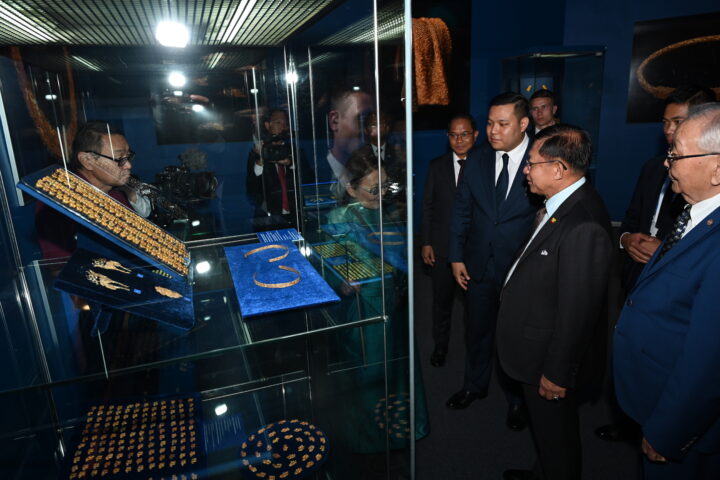
The delegation subsequently visited the National Museum of Tuva, where they were welcomed by the museum head and officials. They viewed exhibitions featuring Buddhist statues from the period of the Tuvan People’s Republic, traditional household items, jewellery, hunting tools and weapons, ancient cultural artefacts, traditional Tuvan clothing and displays depicting the traditional way of life of the Tuvan people.
President U Min Aung Hlaing asked questions and discussed matters of interest before posing for a group photo.
Founded in 1929 and relocated to its present premises in 2008, the National Museum of Tuva preserves and displays the historical and cultural heritage of the Tuvan people. The museum has 24 exhibition halls covering rare artefacts and documents from the Tuvan People’s Republic era, ethnic heritage, shamanism, Buddhism and Orthodox Christianity, as well as the participation of Tuvan people in the Great Patriotic War.
Kyzyl, the capital of Tuva, is located in southern Siberia and is surrounded by the Sayan and Altai mountain ranges. The landlocked region features extensive valleys and plains, while the Yenisei River flows through the area and supports agriculture and livestock farming. Horse breeding is also an important part of Tuvan traditional heritage.
Tuva is known for its distinctive cultural traditions, which combine influences from Central Asia and Siberia. Tibetan Buddhism, Orthodox Christianity and shamanic beliefs coexist in the region. Kyzyl is also home to one of Russia’s largest Buddhist temples and a Buddhist university, while the city recently hosted the Fourth International Buddhist Forum, attended by Buddhist monks and prominent figures from political, administrative and social fields from various countries.
Tuvan throat singing, in which a single performer produces sounds resembling the flow of a river, wind and horses, is another distinctive feature of the region’s traditional culture. With its dramatic climate, rich cultural heritage, natural landscapes and history, Tuva is regarded as one of the Russian Federation’s distinctive and scenic regions.
MNA/ST
#TheGlobalNewLightOfMyanmar