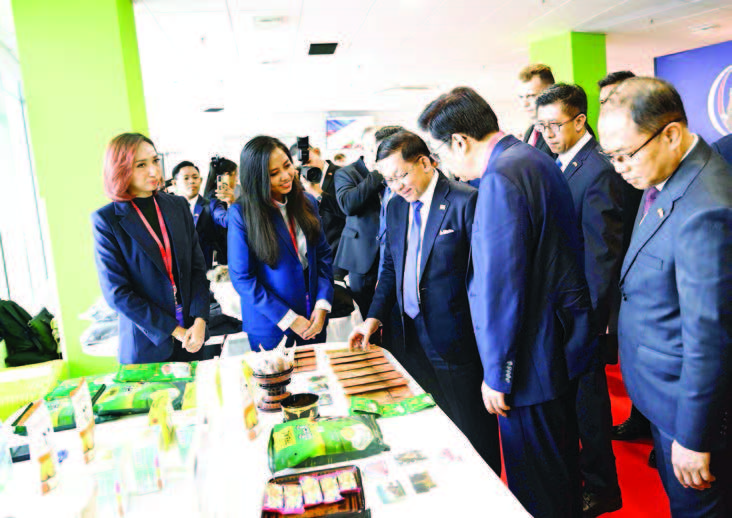
President of the Republic of the Union of Myanmar U Min Aung Hlaing, who was in Russia on an official visit, delivered a speech at the 2026 Russia-Myanmar Business Forum held at the G V Plekhanov Russian University of Economics in Moscow yesterday.
In his speech, the President expressed his pleasure at having the opportunity to speak at the forum, which was organized to deepen economic cooperation between Myanmar and the Russian Federation. He said he believed that the current visit would further strengthen friendship and economic cooperation between the peoples of Myanmar and Russia and contribute to regional economic development.
Regarding the Myanmar-Russia bilateral relationship, he highlighted that diplomatic relations between Myanmar and Russia were established on 18 February 1948, just 45 days after Myanmar regained independence, and that the two countries would mark the 80th anniversary of their diplomatic relations in 2028.
Through decades of mutual understanding, trust and friendship, bilateral relations have now developed into a strategic partnership.
Therefore, there is considerable potential to further expand mutually beneficial cooperation not only between the two governments but also among the peoples and business communities of the two countries.
He noted that new opportunities are emerging in the global economy amid changes in supply chains, technological advances and regional cooperation. Despite the growing geopolitical and economic challenges facing the world, Myanmar-Russia relations have continued to develop in the international landscape through mutual understanding and trust.
In particular, trade and investment ties, based on the countries’ diplomatic relations, are important drivers of bilateral friendship, economic development and prospects.
At present, Myanmar mainly exports mango paste, value-added products and garments to Russia, while importing petroleum products and fertilizers from Russia. Discussions are also underway to increase exports of Myanmar products such as rice, pulses, maize, sesame and fishery products. Myanmar’s Pawsan rice is a premium variety with strong market potential.
Russia has already undertaken investment projects worth US$97.359 million in Myanmar’s oil, natural gas and industrial sectors. Looking ahead, there is confidence that Myanmar and Russia can further deepen cooperation in agriculture, energy, infrastructure, industry, science and technology, education and human resource development.
He continued that Myanmar is strategically located at the crossroads of South Asia, South-East Asia and China, making it important both geopolitically and economically. It is an ASEAN member and shares borders with China, Laos, Thailand, India and Bangladesh. The country has a population of more than 51 million, with Nay Pyi Taw as the administrative city and Yangon as the commercial city.
Myanmar has a large working-age population, accounting for 66.9 per cent of the total population. Since 2001, Russia has provided education and training to more than 7,000 Myanmar students in fields such as politics, economics, technology and management.
With a hot and humid monsoon climate, Myanmar has favourable conditions for year-round agriculture and livestock farming. The government is promoting modern agricultural and livestock-based production, MSMEs and other economic sectors. Myanmar also has abundant mineral resources, including copper, gold, silver and coal, providing opportunities for value-added mineral processing as well as coal-based power and fertilizer production.
For the infrastructure sector, the President added that the government is working to attract greater domestic and foreign investment by creating a clearer, more stable and transparent business environment, streamlining procedures and providing appropriate policy support. It is particularly encouraging quality and responsible investments while emphasizing maintaining a sustainable ecosystem and a balanced economy. The government will provide necessary support to the extent possible and is undertaking economic reforms to improve the country’s business and investment environment. For example, tariff rates have been reduced for investments related to electric vehicles (EVs) and associated industries. The country is also accelerating digital transformation to make processes easier and faster and is developing the Myanmar Digital Roadmap 2030.
The President also highlighted the market potential, saying Myanmar has a strong domestic market and access to the major international markets of China, India and ASEAN countries, not only through land routes but also through ports along the Bay of Bengal and the Gulf of Mottama. Myanmar is also a strategically located land transportation hub, or “choke point,” facing the Indian Ocean. With India having a population of 1.47 billion, China 1.41 billion and ASEAN member states more than 660 million, Myanmar serves as a bridge between the Southeast Asian and Asian markets. A 4,000-kilometre-radius circle centred on Nay Pyi Taw would encompass an area containing about four billion people, or half of the world’s population.
Myanmar is located at the centre of major regional connectivity routes, including the India-Myanmar-Thailand Trilateral Highway, the ASEAN Highway Network, the East-West Economic Corridor and the China-Myanmar Economic Corridor. Given its strategic geographic position, Myanmar is a member of ASEAN, the Lancang-Mekong Cooperation framework and BIMSTEC, and is also a dialogue partner of the Shanghai Cooperation Organization.
Myanmar’s participation in the Regional Comprehensive Economic Partnership (RCEP), one of the world’s largest free trade agreements, also provides opportunities to expand trade links with countries such as China, Japan, South Korea and Australia.
Myanmar offers a wide range of investment opportunities due to its fertile agricultural land, abundant natural resources, and freshwater and marine resources. Russian investors are encouraged to invest in agriculture, livestock, agricultural machinery, seed technology, research, value-added food and fishery processing, manufacturing, technology-based industries, cold storage and logistics. Energy is another key area for Myanmar-Russia cooperation, with opportunities in oil and gas, petroleum refining, fertilizer production and natural gas exploration. Myanmar has more than 1,000 rivers, including four main rivers such as Ayeyawady, Thanlwin, Chindwin and Sittoung, and streams and significant hydropower potential, estimated at 100 GW, with 40-50 GW considered commercial production.
The country also has strong potential for solar energy with a 51973.8 TWh per year production rate, particularly in the central dry zones such as Magway, Mandalay and Sagaing. Tourism offers further opportunities, with Myanmar’s natural beauty, cultural heritage and unique destinations attracting Russian and international visitors and creating potential for investment in tourism-related services.
He continued that the country has many tourist attractions, including the Maravijaya Buddha Image and surrounding stone stupas in Nay Pyi Taw, the renowned Shwedagon Pagoda in Yangon, Kanbawzathadi Palace in Bago, and Mandalay Palace. The country also boasts famous beaches such as Ngapali, Chaungtha and Ngwehsaung, with November to February being the best time to visit due to the pleasant weather. Ancient cultural sites such as Sri Ksetra, Hanlin, Beikthano, Bagan and Inwa, dating from the 4th to 9th centuries AD, offer rich historical heritage, unique cultural traditions and scenic landscapes, providing attractive opportunities for visitors.
Regarding entry arrangements, the reciprocal visa exemption for diplomatic and special/service passport holders of Myanmar and Russia, allowing stays of up to 90 days, came into effect on 27 January 2026. Ordinary tourists are also eligible for a 30-day visa exemption, except for those entering for employment, study or permanent residence.
He added that the global economy is undergoing rapid digital transformation, and investment in digital technology is an investment in Myanmar’s future economic competitiveness. In the ICT sector, Myanmar’s first and largest ICT hub, the Yadanapon Cyber City project, has been established near PyinOoLwin in central Myanmar.
PyinOoLwin is well known as a hill resort city with a pleasant climate and beautiful surroundings. It is also located near Mandalay, an important economic centre, and is accessible year-round by road. An international-standard airport capable of handling jet aircraft has also been established, facilitating domestic and international travel.
Yadanapon Cyber City already hosts a major internet and telecommunications hub developed by Yadanapon Teleport. The project covers about 4,047 hectares and includes office facilities for IT startups and software companies, business incubation centres, technology universities and training institutions.
A High-Tech Zone has also been designated for environmentally friendly technology- and service-based manufacturing. Russian investors interested in digital transformation of government services, communications technology, artificial intelligence (AI), digital payment systems and innovation-driven business development are invited to invest in these sectors. Russian investors can establish not only industrial zones and special economic zones but also integrated agricultural zones and industrial projects in Myanmar.
Myanmar has three special economic zones: Thilawa, Dawei and Kyaukpyu. Thilawa Special Economic Zone in Yangon Region is currently the most successful and, with access to maritime routes, is well suited for export-oriented and manufacturing businesses.
The Dawei Special Economic Zone, which is being jointly implemented by Myanmar and Russia, is expected to become strategically important in the future, and Russian investors are invited to participate in investment opportunities there.
The Dawei Deep Sea Port and Special Economic Zone Development Project, LNG terminals, oil refineries, power plants and natural-gas-based infrastructure upgrade projects are strategic projects for bilateral cooperation. Myanmar also welcomes responsible investments in the modern exploration and development of its mineral and natural resources, including value-added processing, while emphasizing the development of local workers’ skills and environmental protection. Such Myanmar-Russia joint ventures can help develop domestic supply chains and create opportunities to increase exports to regional and international markets.
For facilitation the financial flows, Myanmar’s seven state-owned banks and 25 private banks are maintaining connections with international banks and financial institutions for domestic and international financial transactions.
Direct cooperation between businesses is also underway to facilitate banking and payment systems between Myanmar and Russia. Russia’s Mir Card payment system has already been directly connected to Myanmar’s Myanmar Payment Union (MPU) network through a Host-to-Host connection.
Therefore, Russian tourists and businesspeople can use Mir Cards in Myanmar to withdraw cash from banks and ATMs and make convenient payments at stores and hotels. Direct kyat-ruble payment arrangements can also now be used to facilitate bilateral trade and reduce transaction costs for businesses. This system is expected to further strengthen economic cooperation between the two countries.
Efforts are also underway to establish Myanmar-Russia trade offices to further promote bilateral economic cooperation and trade. Myanmar is not only seeking to increase bilateral trade with Russia but is also emphasizing cooperation with the Eurasian Economic Union (EAEU). Developing new markets for agricultural, fisheries, garment and manufacturing products can create greater opportunities for Myanmar products to enter the Eurasian market.
Moreover, the Myanmar-Russia Agreement on the Promotion and Protection of Investments entered into force on 11 April 2026, while a memorandum of understanding on economic and investment cooperation between the two countries was signed on 4 June 2026. Similarly, Myanmar is also protecting domestic products and investments in accordance with four intellectual property laws.
He added that Myanmar underscores the importance of technology transfer, creating quality employment opportunities and developing domestic industries when inviting foreign investment. At the same time, investors’ interests will be protected in accordance with relevant policies.
Myanmar has a large workforce and more than 33 million acres of agricultural land, along with fertile soil and a favourable climate, making it well suited for agriculture and livestock farming. Its long coastline also provides strong potential for freshwater and marine aquaculture, with opportunities to export products to regional and neighbouring markets.
The country is also rich in oil, natural gas and mineral resources, while Russia has advanced agricultural technologies and expertise in mining, renewable energy and other technology sectors. Therefore, combining Myanmar’s abundant resources and strategic location with Russia’s technology and experience offers strong potential for long-term, sustainable and mutually beneficial economic development between the two countries.
In conclusion, he stated Myanmar would continue to cooperate with Russia as a reliable strategic economic partner on the path towards long-term development. He expressed his desire for the two countries to jointly build “a partnership based on trust, development driven by technology, and a mutually beneficial future”. Myanmar invites Russian businesspeople, investors and technology companies to invest in Myanmar and work together as long-term development partners. He continued that as bilateral relations continue deepening, the two countries will be able to jointly achieve sustainable, strong and mutually beneficial economic development.
After the session of delivering a speech, Rector Mr Lobanov Ivan Vasilyevich presented President U Min Aung Hlaing with the G V Plekhanov Russian University of Economics Medal of Merit.
The President and attendees then posed for a documentary group photograph.
At the university’s Situation Centre, the officials gave presentations to the President and delegation on economic development and changes in Russia, including population and GDP data, foreign investment, financial information and foreign exchange rates, as well as market trends.
They also explained the university’s information analysis and research activities, including estimates of Myanmar’s population, geographic conditions and regional income and expenditure based on data from Myanmar, direct regional monitoring of maritime activities and components of the university’s low-orbit satellites, research on science and technology development and education, and assessments of developments in IT technology across universities.
The President asked questions and held discussions on matters of interest following the presentations. He then presented commemorative gifts to the Rector.
The President departed from G V Plekhanov Russian University of Economics and was warmly seen off by the rector and faculty members. — MNA/KTZH
#TheGlobalNewLightOfMyanmar