
By Dr Aung Tun
A hospital building can be completed in months. Training a doctor, including postgraduate specialization, can take more than a decade. That simple contrast explains why countries everywhere, rich and poor, find that the hardest part of building a health system is not the bricks and equipment but the people. Doctors, dental surgeons, nurses, midwives, pharmacists, laboratory technicians and public health staff are the means by which medicines, vaccines and technology actually reach patients. Without them, a well-stocked clinic is simply a closed door.
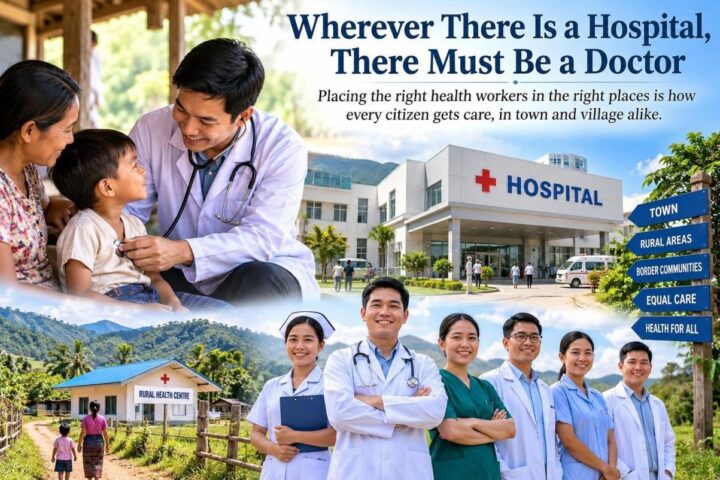
For Myanmar, where the aim is that wherever there is a hospital there must be a doctor, the questions of who works where, and how long they stay, deserve careful attention from everyone who cares about public health.
People Are the Heart of a Health System
The World Health Organization (WHO) has long described the health workforce as the backbone of every health system. Its World Health Report 2006 identified 57 countries facing a critical shortage, defined as fewer than 2.3 doctors, nurses and midwives per 1,000 population. More recently, WHO’s Workforce 2030 strategy estimated that an indicative threshold of about 4.45 doctors, nurses and midwives per 1,000 population is associated with the capacity to deliver essential services and move towards universal health coverage.
The gap will not close by itself. WHO projects a global shortfall of around 10 million health workers by 2030, concentrated mainly in low- and lower-middle-income countries. At the same time, populations are ageing, noncommunicable diseases are rising, and health emergencies are becoming more frequent, all of which increase the demand for skilled people.
The lesson is straightforward. Numbers matter, but so do skills, distribution, motivation and working conditions. A sound workforce plan has to address all four.
National Directives: A Doctor in Every Hospital
At the commissioning ceremony for newly graduated doctors and dental surgeons in Yangon on 12 October 2026, President U Min Aung Hlaing set out the national direction on human resources for health. The guiding principle is that nothing is more important than human life, and that wherever there is a hospital, there must be a doctor.
To achieve this, graduates are appointed directly to public hospital vacancies right after their internships, and five-, ten- and fifteen-year human resource roadmaps have been outlined for hospitals from regional to station level. The government continues to attend to accommodation, welfare and allowances for medical personnel. The health sector’s share of state expenditure increased from about 1.5 per cent in 2000 to 2.8 per cent in 2026-2027. Training capacity has expanded to 17 medical and allied universities, with curricula aligned to international standards. The President also called for ethical, empathetic practice, lifelong learning, and a rise in life expectancy from 69 years to over 70 by 2030.
Closing the Rural-Urban Gap
Almost everywhere in the world, health workers gather in cities. WHO has noted that about half of the global population lives in rural areas, yet those areas are served by only around 38 per cent of nurses and less than a quarter of doctors. Remote villages and border communities, which often carry the heaviest burden of disease, end up with the fewest providers.
Prompt placement of fresh graduates is one of the most practical tools for narrowing this gap. In July 2025, for example, 1,276 doctors and 23 dental surgeons were appointed to public posts for service in different regions. Yet a doctor alone cannot run a rural health service. Township and station hospitals depend on a team: nurses, midwives, health assistants, laboratory staff and ambulance crews. Placement plans should therefore count the whole team, not only the physician.
Fair distribution is ultimately a matter of equity. A family in a remote township deserves the same standard of safe, respectful care as a family in a big city. Good planning begins by mapping where the people are, where the health workers are, and where the two do not match, and then closing the gaps in a deliberate, step-by-step way.
Keeping Health Workers Where They Are Needed
Getting a health worker to a remote post is only half the task. Keeping them there is the other half. WHO’s global recommendations on rural retention group the evidence into four areas: education, regulation, financial incentives, and personal and professional support.
In practice, this means recruiting students from rural backgrounds and supporting pathways for them to serve their communities. It means training that reflects rural realities, fair allowances for hardship postings, and decent housing and safe working conditions. It also means a clear career path, so that a posting in a township hospital leads to specialist training and promotion rather than professional isolation. Supportive supervision, reliable internet for consultation and recognition for good service all matter. Small improvements in daily working life often decide whether a skilled worker stays for months or for years.
Training for Quality and Teamwork
Quantity without quality does not save lives. Myanmar’s training capacity now covers six medical universities and 11 allied medical universities, a total of 17 institutions, with curricula reformed around outcomes and international standards. Competency-based education focuses on what graduates can actually do, such as diagnosing common conditions, managing emergencies and communicating clearly, rather than on how much they have memorized.
Inter-professional education is equally important. When medical, dental, nursing, midwifery and public health students learn side by side, they understand one another’s roles and are better prepared to work as one team once they reach the ward or the village health centre. Modern health problems such as diabetes, hypertension, stroke and tobacco-related disease cannot be managed by any single profession alone. WHO’s Workforce 2030 strategy calls for education that matches population needs and for training that continues throughout a career.
A Team for Prevention, Not Only Treatment
Doctors in hospitals treat illness, but much of the gain in life expectancy comes from prevention. Immunization, safe motherhood, nutrition, tobacco control, hypertension screening and healthy ageing programmes are delivered largely by midwives, nurses, basic health staff and public health professionals working in communities.
Official figures put Myanmar’s life expectancy at about 69 years, and the national aim is to raise it beyond 70 by 2030. Reaching that goal depends on a balanced workforce. A strong hospital service must be matched by a strong primary health care and public health service, because preventing avoidable illness and hospital admission is a central goal of public health. Investing in health promotion, including school health teams and community volunteers, can strengthen prevention at the local level.
Noncommunicable diseases such as heart disease, stroke, cancer, diabetes and chronic lung disease now cause most deaths worldwide, and many are linked to tobacco use, unhealthy diets, physical inactivity and harmful use of alcohol. Health workers are among the most trusted voices on these risks. A doctor who asks every patient about smoking, or a midwife who advises a young mother on a smoke-free home, multiplies the impact of the health system far beyond the clinic.
Care with Compassion, Learning for Life
Skills and systems are not enough without the right attitude. Patient-centred care begins with simple things: listening, explaining a diagnosis and treatment plan in plain language to the patient and family, protecting confidentiality, and respecting dignity, whatever a person’s income or background. Respectful communication can strengthen trust and support treatment adherence.
Learning must also continue long after graduation. Medical knowledge changes quickly, and doctors who keep reading, reviewing their practice and conducting research are the ones who keep their patients safe. Postgraduate study and specialization strengthen local services. Emerging tools such as artificial intelligence, digital health platforms and telemedicine can extend the reach of a single clinician to patients in distant places, but they support, and never replace, the human touch of a caring professional. A hospital without a doctor is a building, and a doctor without support is a lonely struggle. A health system that invests in its people, places them fairly, keeps them motivated and trains them well is one in which every citizen, in town and village alike, can expect to be cared for.
References
World Health Organization. The World Health Report 2006: Working Together for Health. Geneva: WHO; 2006.
World Health Organization. Global Strategy on Human Resources for Health: Workforce 2030. Geneva: WHO; 2016.
World Health Organization. Working for Health Action Plan 2022-2030. Geneva: WHO; 2022.
Global New Light of Myanmar. New Doctors and Dental Surgeons Commissioned into Civil Service to Boost Public Healthcare. 13 October 2026; pp. 1 and 4 (MNA).
World Health Organization. Increasing access to health workers in remote and rural areas through improved retention: global policy recommendations. Geneva: WHO; 2010.
#TheGlobalNewLightOfMyanmar