
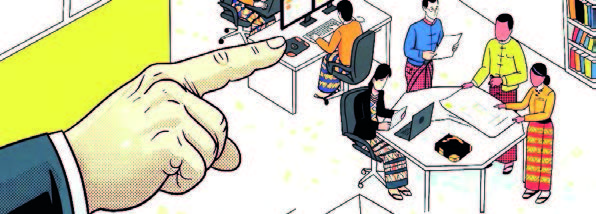
A pointing finger may identify a person, but it does not necessarily identify the cause of a problem. When something goes wrong, the easiest question is often, “Who is to blame?” The more useful question is, “What happened, why did it happen, and how can we prevent it?”
The difference can determine whether an institution merely punishes mistakes or learns to improve.
Japan gave this approach an organized form through quality circles. The movement began in 1962 under Professor Kaoru Ishikawa, working with the Union of Japanese Scientists and Engineers. He encouraged frontline workers to form small groups to study quality control and improve their work. Its origins were broader than a single motorcar factory. (juse.or.jp)
A quality circle brings together people familiar with a particular area of work. They identify a manageable problem, examine evidence, propose changes and assess the results. Its purpose includes solving problems, but its spirit is cooperation rather than accusation.
For Myanmar, this offers a practical opportunity. Institutions are made of people drawn from society. Habits learned in homes, classrooms and communities accompany us into offices, hospitals, factories and uniformed services. When admitting an error invites humiliation, silence can become a means of self-protection.
Yet silence does not repair a faulty machine or improve a public service. Sweeping dust beneath the carpet leaves the room unclean.
Blame also has a quieter companion: cognitive bias, the tendencies in human thinking that can distort judgement without our awareness. Education, seniority and good intentions do not make anyone immune.
Confirmation bias leads us to favour evidence that supports an existing belief. Once an employee is labelled “careless”, every subsequent mistake may appear to confirm that judgement. Their competent work and weaknesses in the working system may receive less attention. Anchoring keeps us attached to the first explanation, even when later evidence challenges it. (psnet.ahrq.gov)
An investigation can consequently become an exercise in proving an accusation rather than discovering what happened.
Hindsight bias creates another trap. After knowing the outcome, we may feel that the danger should have been obvious from the beginning. Fair judgement asks what information, resources and choices were available at the time. Yesterday’s uncertainty should not be judged as though everyone possessed today’s knowledge. (ahrq.gov)
Rank can influence discussion too. A senior person’s explanation may go unchallenged because of their position. When agreement becomes a duty, useful questions remain unasked. A quality circle must therefore offer more than seats around a table: it must allow respectful differences of opinion.
These concerns can be understood alongside Buddhist principles familiar to many in Myanmar, while remaining relevant to people of every faith and none.
Buddhist attention to causes and conditions provides a useful analogy. An error rarely becomes fully understood merely by naming the person involved. Unclear instructions, inadequate training, excessive workload and unsuitable equipment may all require examination. Understanding these conditions supports prevention while preserving individual responsibility.
Right speech offers another guide. In the Abhaya Sutta, the Buddha’s teaching connects speech with truth, benefit and appropriate timing. In a quality circle, this means describing events accurately, speaking constructively and choosing words that help others listen. Courtesy should help truth to be heard; it should never conceal it. (origin. dhammatalks.org)
Metta, loving-kindness, and Karuna, compassion, can guide how colleagues treat one another. Panna, wisdom, encourages careful judgment. Applied to working life, these principles invite us to examine our attachment to being right. Revising an opinion when evidence changes can express both wisdom and humility.
Consider a public office where citizens repeatedly submit incomplete applications. One explanation is that applicants are inattentive; another is that the instructions are confusing. If officials accept only the first explanation, they may overlook an opportunity to improve the service.
A quality circle could examine rejected forms, ask applicants about their difficulties, simplify the guidance and compare results. Fewer repeat visits would provide better evidence of success than another reprimand.
To support fair inquiry, members should distinguish observations from interpretations and consider several explanations. A valuable question is: “What evidence might show that our first assumption is wrong?” Junior staff can offer observations before the most senior person announces a conclusion. Changes should then be tested against agreed measures. Such practices can challenge bias, although a meeting alone cannot guarantee sound judgement.
Compassion also requires accountability. Honest mistakes, repeated disregard of procedures and deliberate misconduct deserve different responses. Serious wrongdoing still requires proper investigation and proportionate action.
The first step need not be expensive: one willing team, one recurring difficulty and one achievable change. Leaders must give members time, listen fairly and act on useful suggestions. Consultation without action soon becomes an empty ceremony.
A nation’s institutions improve when its people can examine both their working methods and their own assumptions.
When a roof leaks, blaming the person who reports the rain will not keep the family dry. We must inspect the roof – and remain willing to discover that our first explanation was wrong.
Let the pointing finger become a helping hand, and certainty give way to enquiry.
#TheGlobalNewLightOfMyanmar