
By Myint Zan
Nobel Prize announcements for 2026 have concluded. Yours truly watched the announcements live webcast from the website www. nobelprize.org
Questions and Answers on Human Consciousness at the 2026 Announcement of the Nobel Prize in Physiology or Medicine
The Nobel laureates’ bio-datum and their contributions and explanation of their discoveries for the 2026 Nobel Prize in Physiology or Medicine can be read at the above website. This article will reproduce a question asked at the end of the announcement of the Physiology or Medicine Prize. The answers given in reply will be reproduced and commented on.
Questions and answers from the Physiology or Medicine session can be seen in the YouTube video of the announcement from 18 minutes 50 seconds to about 20 minutes. The questioner asked, ‘How does the brain create consciousness … can anyone speculate whether the tool (discovered by the Nobel Medicine laureates) helps answer how the inner subjective world occurs from neuronal activity’? In short, the question seems to be about how human consciousness arises and how it operates.
Parts of the answer given by Nobel selection committee member Professor Abdel El Manira (born 28 January 1965) state, ‘we are far from understanding (how consciousness arises) …we have to be humble about grand questions…’. In response to the subsequent query as to whether more concrete discoveries or findings can be made in the years ahead, the announcer Professor Thomas Perlmann (born 2 March 1959) stated, ‘may be there could be a Nobel Prize some years in the future’.
Perhaps those two statements by the two learned scientists need to be viewed jointly and contrapuntally. To paraphrase the poem ‘miles to go before I sleep’, of Robert Frost (26 March 1874-29 January 1963), neuro-scientists and future Nobel Physiology and Medicine laureates had perhaps years, even decades, to come to arrive at an explanation of ‘how humans’ inner subjective world operates from neuronal activity’.
Almost immediately after this exchange, broadcast live on television, I was reminded of a book published in 1991 with the grand title (refer to the comments of ‘grand question’ by Professor Abdel El Manira above) Consciousness Explained. The author of the book was Daniel Dennett (28 March 1942-19 April 2024), a philosopher who taught at Tufts University in the United States. Dennett was not a neuroscientist.
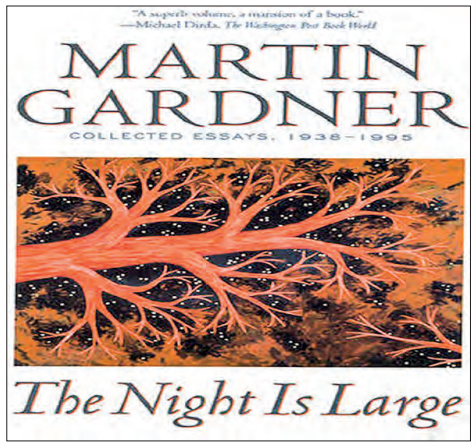
The polymath, the late Martin Gardner (21 October 1914-22 May 2010), in the Introduction to his book The Night is Large: Essays 1938-1995, stated that Dennett’s Consciousness Explained was ‘brazenly titled’. Martin Gardner’s expertise includes, but is not limited to, aspects of mathematics and mathematical games. He was also a debunker of pseudo-science. As early as 1952, Gardner had published his book Fads and Fallacies in the Name of Science. At that time, Dennett was only about ten years old. I write this to state that Gardner was not a ‘fringe person’ to critique Dennett. Later, around 1983, Gardner outed himself as a ‘mysterian’. Consequently, Gardner is of the firm view that consciousness can only, at best, be described or explained away, not ‘explained’. He was of the view that since a dog’s brain cannot do calculus or compose a symphony (not to say even add five plus five, yours truly would add), so humans’ brains had limits to understand their own workings. In December 1995, Gardner wrote:
QUOTE
The question is whether we knew enough about quantum mechanics or undiscovered laws that may underlie quantum mechanics to explain consciousness and free will. Dennett thinks it is all very clear and easily explained. Indeed, he believed he had explained it. …
We believe that there are deep mysteries about the brain that neurobiologists are nowhere close to solving
(Emphasis added) UNQUOTE Martin Gardner, The Night is Large (Penguin Books), pp. xviii-xix.
More than 30 years after Gardner wrote Abdel Al Manira (as mentioned above) in October 2026 stated, ‘we are far from understanding how consciousness arises’. Was Dennett overconfident or even arrogant in his claim (or is it an exclamation?) in 1991 that he had explained consciousness?
If Dennett and Gardner were to come back and listen to the three-minute exchange of views between the questions and the answers provided (a long way to solving the consciousness problem), what would they have commented?
It is notable, indeed noteworthy, that Prof. Perlmann, the Chair in the 2026 Nobel Prize in Physiology or Medicine announcement, stated that the more concrete views and discoveries of the nature of consciousness may, in the future, receive the Nobel (medicine?) prize. He did not give a timeline for that postulated or hoped-for eventuality.
Daniel Dennett and Martin Gardner had opposed views on the knowability (so to speak) or otherwise of the full nature and workings of human consciousness. Neither were Nobel laureates in any field.
Nevertheless, what would they have commented on Professor Perlmann’s statement that some persons in the (near, medium term or distant?) future might receive a Nobel Prize in the sciences for solving or effectively ‘tackling’ the ‘grand question’ about human consciousness? Such research and possible future Nobel prizes may not be restricted to the fields of physiology or medicine but may also extend to the other scientific fields of chemistry and physics, but – one might mischievously add – not ‘economic sciences’.
#TheGlobalNewLightOfMyanmar