
By Chit Nay Zin Maung
Artificial Intelligence (AI) technology is rapidly transforming many areas of modern society, and education has emerged as one of the fields with the greatest potential for positive change. From personalized learning and intelligent tutoring to lesson preparation, educational research, and administrative support, AI is creating new opportunities for teachers and students. The arrival of Generative AI has accelerated this transformation. Unlike earlier digital technologies, Generative AI can interact with learners through natural language, generate educational content, provide explanations and feedback, and support teachers in designing learning activities.
The OECD’s Digital Education Outlook 2026 describes Generative AI as a potentially powerful teaching assistant, learning partner, and educational tool when it is used with clear pedagogical purposes. Therefore, the question is no longer whether AI should have a place in education. Instead, the important question is how education systems can use AI intelligently and responsibly to improve learning outcomes while preserving the essential human role of teachers.
AI as a New Learning Partner
One of the most promising applications of AI in education is personalized learning. Students have different abilities, interests, learning speeds, and educational needs. Traditional classroom teaching can make it difficult to respond individually to every learner. However, AI-powered educational systems can provide explanations, exercises, and feedback that are adapted to individual needs.
Moreover, AI can function as an interactive learning partner. Rather than simply providing an answer, an educational AI system can ask questions, encourage students to explain their reasoning, and provide guidance when they encounter difficulties. In this way, AI can support students throughout the learning process rather than simply completing tasks for them.
Developing Critical Thinking and Creativity
There is sometimes a concern that AI may prevent students from thinking for themselves. Although this concern is important, it also highlights the need for a better model of AI-supported education. When AI is used merely to provide answers or complete assignments, students may become passive users who lack active engagement in learning.
However, when teachers intentionally integrate AI into problem-solving, discussion, and collaborative learning, it can become a powerful tool for developing higher-order thinking skills. Students can use AI to compare different explanations, identify weaknesses in arguments, ask follow-up questions, and explore alternative solutions to problems.
The OECD has found that when Generative AI is used with clear educational purposes, it can support skills such as critical thinking, creativity, collaboration, and argumentation. Therefore, the goal should not be to prevent students from using AI. Instead, students should be taught not simply how to let AI think for them, but how to think with AI without surrendering their own judgment.
AI and Educational Opportunities
One of the major benefits of AI is its potential to expand access to high-quality educational resources. Students in remote and underserved communities, where educational resources may be limited, can benefit from AI-supported learning tools if they have adequate connectivity, devices, and digital skills.
One of the major benefits of AI is its potential to expand access to high-quality educational resources. Students in remote and underserved communities, where educational resources may be limited, can benefit from AI-supported learning tools if they have adequate connectivity, devices, and digital skills.
AI can provide explanations at different levels of difficulty, support language learning, offer additional practice, and make educational resources available beyond normal classroom hours. This potential is particularly important for developing countries.
If governments invest simultaneously in digital infrastructure, teacher training, and affordable access to educational technologies, AI could help reduce some forms of educational inequality. However, technological access must go hand in hand with digital literacy. Simply providing AI tools does not automatically create better education. Students and teachers need the skills to use these technologies effectively, critically, and responsibly.
A Human-Centered Approach
The positive potential of AI must be accompanied by responsible governance. UNESCO’s guidance on Generative AI in education and research supports a human-centred approach that promotes ethical, safe, equitable, and meaningful uses of AI. It also emphasizes data privacy and appropriate policies.
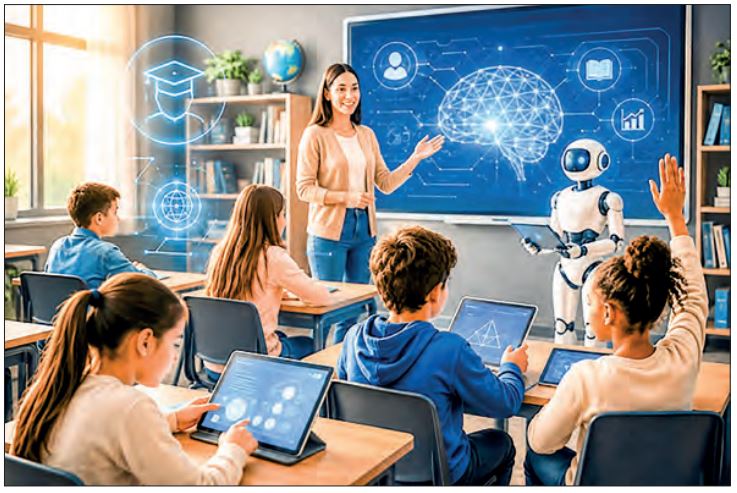
This principle is especially important because education is not simply about transferring information. It is also about developing human character, creativity, communication skills, values, and citizenship. Therefore, AI should serve only as an agent of support. Teachers should remain responsible for important educational decisions, while students should remain actively involved in their own learning.
Preparing Teachers and Students for the AI Era
Successfully integrating AI requires a new form of educational knowledge. Teachers need professional development that covers not only how AI tools work but also how to incorporate them into effective teaching strategies.
Students also need AI literacy. They should understand how AI systems generate information and recognize that AI can produce inaccurate or biased responses. They should know how to protect their personal information and understand appropriate ways to use AI in educational activities.
Therefore, educational institutions should establish clear guidelines covering academic integrity, privacy, responsible AI use, and assessment. UNESCO emphasizes the need for capacity building and coherent policy frameworks to ensure that AI provides meaningful support in education and research.
Looking Towards the Future
The future of education will not be determined by technology alone. It will depend on how wisely societies combine technological innovation with human values. AI has the potential to make learning more personalized, make teachers more effective, increase access to educational resources, and improve the efficiency of research.
Therefore, the priority for policymakers should be to create an environment in which innovation and responsibility develop together. Investment in digital infrastructure, teacher training, educational AI research, data protection, and equal access will be essential.
To put it in a nutshell, Artificial Intelligence is one of the most significant opportunities for transforming education in the twenty-first century. When properly integrated, AI can provide students with personalized support, assist teachers with challenging tasks, encourage creativity and critical thinking, and expand learning opportunities.
However, the true value of AI in education does not lie in replacing human intelligence but in enhancing it. The classroom of the future should combine the analytical capabilities of AI with the wisdom, empathy, and creativity of teachers and students.
Therefore, the challenge for the future is not to choose between humans and machines. Instead, it is to build an education system in which human beings remain at the centre while AI becomes a powerful partner in learning.
OECD: The Organization for Economic Co-operation and Development is an international organization that studies economic and social issues and gives policy advice to governments.
#TheGlobalNewLightOfMyanmar