
Over the past several decades, humanity has witnessed some of the most dramatic environmental changes in modern history – from melting glaciers and deforestation to rising global temperatures. Yet another, less visible crisis is now demanding urgent attention: microplastic pollution.
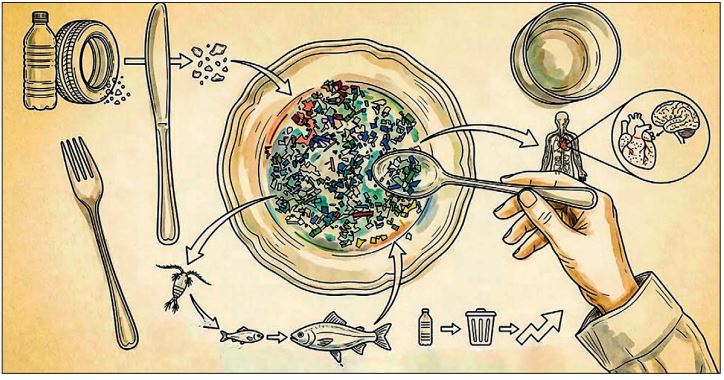
These tiny particles, generally measuring less than five millimetres, have spread far beyond landfills and polluted coastlines. They are now being detected in oceans and rivers, agricultural soils, household dust and the atmosphere. Scientists have also found plastic particles in human biological samples, raising growing questions about their potential effects on human health.
Unlike many conventional pollutants, microplastics are exceptionally persistent. They do not simply disappear when larger plastic products break apart. Instead, plastic materials can fragment into progressively smaller particles through sunlight, heat, physical abrasion and chemical processes. As a result, plastic waste can remain in the environment for decades or longer, continually generating smaller particles.
The growing evidence suggests that microplastics should no longer be regarded merely as a marine pollution problem. They are becoming a global environmental challenge connecting the atmosphere, freshwater systems, soil, food chains and human health.
What Are Microplastics?
Microplastics are commonly defined as plastic particles smaller than five millimetres. They come in many forms, including fragments, fibres, films and tiny particles that may be invisible to the naked eye.
Some are deliberately manufactured at small sizes, while others are created when larger plastic products deteriorate. Synthetic clothing, plastic packaging, vehicle tyres, fishing equipment and numerous consumer products can all contribute to microplastic pollution.
Everyday activities can release these particles into the environment. Washing synthetic textiles can release plastic fibres into wastewater. Vehicle tyres shed particles as they wear down. Plastic products can release tiny fragments through handling and abrasion.
These particles can then move through wastewater systems, rivers, wind and atmospheric circulation. Their small size makes them difficult to control once they enter the environment.
Microplastics in Water: From Rivers to the Deep Ocean
The world’s oceans have become major repositories for plastic pollution. Microplastics have been detected from surface waters to deep marine environments, where they can interact with marine organisms throughout the food web. Fish, seabirds, turtles and other marine animals may ingest plastic particles accidentally. Larger plastic debris can cause physical injury or digestive problems, while smaller particles may introduce additional chemical and biological concerns.
Microplastics can also interact with pollutants in the surrounding environment. Their surfaces can accumulate certain chemicals, meaning that plastic particles may act as carriers of pollutants under some environmental conditions. The concern extends beyond the oceans. Rivers, lakes and wetlands are also affected. Rivers can transport plastic waste from cities and inland communities toward coastal areas, while lakes and other freshwater systems can accumulate particles from local sources.
This is particularly significant because freshwater ecosystems are closely connected to human drinking-water supplies and food production. Although modern water-treatment systems can remove a substantial proportion of microplastics, their effectiveness varies according to particle size, shape, material and treatment technology. The message is clear: microplastic pollution does not stop at the shoreline.
Microplastics in Soil and Agriculture
While public attention has traditionally focused on plastic pollution in the oceans, scientists are increasingly examining the accumulation of microplastics on land.
Agricultural soils can receive microplastics from several sources, including plastic mulch used in farming, wastewater and sewage-derived materials, contaminated irrigation water, atmospheric deposition and the breakdown of plastic waste.
Once present in soil, microplastics may alter physical properties such as soil structure, water movement and nutrient cycling. They can also interact with microorganisms and soil organisms that play important roles in maintaining healthy agricultural ecosystems. The consequences for crops and food production remain an active area of scientific research. Some experimental studies have found that microplastics can influence plant growth and root development, although the magnitude of these effects varies according to the type, size and concentration of the particles.
Scientists have also investigated whether plants can take up very small plastic particles through their roots. Evidence suggests that certain particles can enter plant tissues under particular conditions, raising important questions about the movement of plastics from contaminated soils into agricultural food systems. This creates a potentially important pathway: from plastic waste to soil, from soil to crops, and ultimately from food to people. More research is needed to determine how significant this pathway is under real-world agricultural conditions.
Microplastics in the Air
Perhaps one of the most surprising developments in recent research is the growing recognition that microplastics are also part of atmospheric pollution. Microplastic fibres and fragments can become airborne through household dust, synthetic textiles, tyre wear, construction activities, waste handling and other sources. Wind can transport these particles over considerable distances before they eventually settle on land or water.
Scientists have detected microplastics in locations far from major population centres, demonstrating that atmospheric transport can move plastic particles across geographical boundaries. This discovery changes the way the problem should be understood.
Microplastics are not simply accumulating in places where plastic waste is produced. Some particles can enter atmospheric circulation and travel to distant environments. They can subsequently return to the surface through dry deposition or rainfall.
For humans, inhalation represents another potential exposure pathway alongside food and drinking water. Researchers are investigating how different types and sizes of plastic particles interact with the respiratory system and whether long-term exposure may contribute to inflammation or other biological effects.
The science is still developing, but the emergence of airborne microplastics reinforces an important point: plastic pollution has become an environmental problem that moves through the entire Earth system.
The Human Health Question
One of the most important and controversial aspects of microplastic research concerns human health. Researchers have reported plastic particles in a range of human biological samples, including blood, lung tissue, stool and placental tissue. These findings demonstrate that human exposure is occurring through multiple pathways, including food, water and air.
However, detecting microplastics in the human body does not automatically prove that they cause specific diseases. Scientists are still working to understand which particles can enter particular tissues, how long they remain there, how the body responds to them and what levels of exposure may pose meaningful health risks.
Laboratory and experimental research have nevertheless raised concerns about several possible biological effects, including inflammation, oxidative stress, immune-system responses and interactions with chemicals associated with plastics. Particular attention is being given to nanoplastics, which are much smaller than microplastics and may have a greater ability to interact with cells and tissues.
The potential health consequences therefore deserve careful scientific investigation. Policymakers should respond to emerging evidence while avoiding exaggerated claims that go beyond what current research can demonstrate.
A Pollution Crisis Without Borders
Microplastic pollution is fundamentally a global problem because neither wind nor water respects national borders. Ocean currents can transport plastic particles across regions. Atmospheric circulation can carry particles over long distances. International trade and global consumption patterns also influence where plastic products are manufactured, used and discarded.
Countries with inadequate waste-management infrastructure can face particularly serious challenges, but no country is completely isolated from the problem. This makes international cooperation essential. Governments, scientists and environmental organizations need internationally comparable monitoring systems, standardized methods for measuring microplastics and stronger policies to reduce unnecessary plastic production and leakage into the environment.
The challenge is also closely connected to climate change and other environmental pressures. Extreme weather events can redistribute plastic waste, while environmental degradation can create additional pathways for plastic particles to enter ecosystems.
The result is an increasingly interconnected environmental challenge requiring cooperation across borders and sectors.
What Can Be Done?
There is no single solution to microplastic pollution. A successful response must begin by reducing plastic waste at its source.
Several measures deserve greater attention:
• Reduce unnecessary plastic production and consumption.
• Limit unnecessary single-use plastics.
• Strengthen waste collection, recycling and disposal systems.
• Improve wastewater treatment and filtration technologies.
• Develop safer and genuinely sustainable alternatives to conventional plastics.
• Reduce microplastic emissions from textiles, tyres and industrial processes.
• Improve monitoring and scientific research.
• Educate consumers about responsible plastic use and disposal.
• Strengthen international cooperation on plastic pollution.
Importantly, responsibility cannot rest entirely on individual consumers. Governments and industries have a major role in redesigning products, improving production systems and creating effective circular-economy models in which materials remain in use rather than becoming waste.
A Global Challenge That Requires Collective Action
Microplastics may be tiny, but the challenge they represent is enormous. They have moved from being primarily associated with visible plastic waste to becoming part of a much broader environmental system involving the ocean, freshwater, soil, atmosphere and food chains.
The most important lesson is that plastic pollution does not disappear simply because it is no longer visible. A plastic bottle may break into smaller pieces, but those pieces can remain in the environment and continue to circulate through natural systems.
At the same time, the growing scientific evidence should encourage action rather than fear. Humanity has the technological and policy tools to reduce plastic pollution. Better product design, improved waste management, stronger environmental standards, scientific innovation and international cooperation can all make a difference.
The goal should not simply be to clean up plastic after it has entered the environment. The more effective strategy is to prevent unnecessary plastic from becoming pollution in the first place.
Conclusion: Protecting an Invisible Future
Microplastics represent one of the defining environmental challenges of the modern era – not because every particle is necessarily dangerous, but because their persistence, mobility and enormous number make them extraordinarily difficult to control once released. They can travel through water, air and soil. They can enter food webs and reach places far from their original sources. And their increasing detection in human biological samples has made the issue an important subject of health research.
Yet the future is not predetermined. The world can reduce the scale of the problem by producing less unnecessary plastic, designing products more responsibly, improving waste-management systems and investing in scientific research. International cooperation will be essential because plastic pollution is not confined to individual countries. Microplastics may be almost invisible to the human eye, but their environmental significance is becoming increasingly difficult to ignore.
The smaller the particles become, the bigger the responsibility becomes – to protect the oceans, the soil, the air, human health and the generations yet to come.
#GlobalNewLightOfMyanmar