
Before the disruption, around 120 ships crossed the Strait of Hormuz daily.
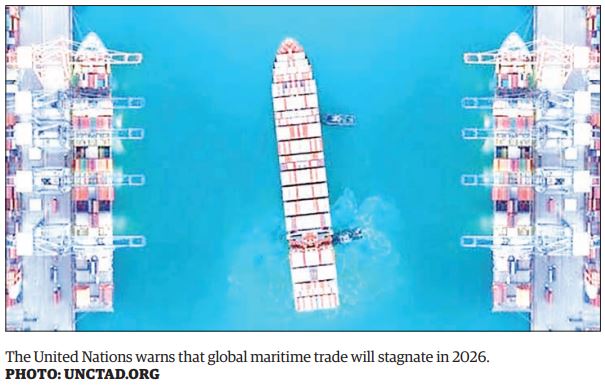
Global maritime trade — which carries more than 80 per cent of the world’s goods — is set to stagnate in 2026 due to shipping disruptions and trade uncertainties arising from the war in the Middle East, the United Nations said Thursday.
“Maritime trade is projected to record zero growth in 2026 after expanding 1.9 per cent in 2025,” the UN trade and development agency UNCTAD said. Ongoing disruptions to maritime traffic through the Strait of Hormuz — a vital shipping route for roughly a fifth of the global oil supply, and other strategic commodities like fertilizer — plus the spread of the conflict to the Red Sea have been complicating trade and causing severe volatility in oil prices in late February.
Before the disruption, around 120 ships crossed the Strait of Hormuz daily. But by early March, traffic measured by gross tonnage had fallen by roughly 95 per cent, said UNCTAD.
The instability in the Red Sea also forced many ships to switch to a longer route around the Cape of Good Hope.
UNCTAD also highlighted disruptions to grain shipments in the Black Sea and via the Panama Canal.
“Disruptions to major shipping routes and chokepoints are lengthening voyages, raising operating costs and freight volatility, and putting additional pressure on supply chains, particularly in developing countries,” the agency said.
The use of other ports, inland transport networks and new logistics solutions has helped to keep trade flowing, albeit at a higher cost, according to UNCTAD. The agency said seaborne trade came in at 12.3 billion tonnes in 2025, up 1.9 per cent, compared to growth of 3.9 per cent in 2024. It projects zero growth in 2026.
Interim UNCTAD chief Pedro Manuel Moreno told a press conference: “Our simulations show that if a fuel shock like these years proceeds through 2027, higher shipping costs alone could push consumer prices in least-developed countries to almost twice the global average increase.” — AFP
#TheGlobalNewLightOfMyanmar