

By U Khin Maung Myint
Understanding the relationship between culture, psychology, Buddhist philosophy, family expectations and modern psychotherapy.
Psychotherapy is not simply a conversation between a therapist and a client. It is an encounter between two human beings, each carrying personal experiences, cultural beliefs, social expectations and moral values.
In Myanmar society, the therapist’s role requires particular sensitivity because emotional suffering is often expressed, understood and managed differently from Western psychological models.
A culturally competent therapist must understand not only what the client is saying, but also what the client feels unable to say.
1. Understanding the Myanmar cultural background
Myanmar society has traditionally been shaped by several interconnected influences:
• Theravada Buddhism: Teachings about suffering (Dukkha), impermanence (Anicca), compassion (Karuna) and Karma (Kamma)
• Family collectivism: The needs, reputation and harmony of the family may take precedence over individual wishes.
• Respect for authority and seniority: Elders, teachers, religious leaders and professionals often occupy respected positions.
• Emotional restraint: Open expressions of anger, disagreement, sadness or personal dissatisfaction may be discouraged.
• Social reputation: Maintaining dignity, avoiding shame and preserving မျက်နှာ (face) can influence behaviour.
These characteristics are neither universal nor necessarily harmful. Their psychological significance depends on the individual, family and circumstances.
For example, respect for parents can provide emotional security. However, excessive expectations of obedience may inhibit autonomy.
The therapist’s responsibility is to recognise both the protective and potentially restrictive aspects of cultural traditions.
2. The therapist as a culturally sensitive listener
In Western psychotherapy, clients are frequently encouraged to express feelings directly.
In Myanmar culture, particularly among older generations, emotional difficulties may be communicated indirectly.
A client experiencing depression might complain of headaches, tiredness, insomnia, loss of appetite or bodily discomfort rather than explicitly describing sadness or hopelessness.
A therapist should therefore explore the emotional significance of physical complaints without prematurely assuming that they are psychological.
Consider a Myanmar woman who says:
“I am not unhappy. I simply cannot sleep because I think too much about my family.”
The therapist should explore whether this represents ordinary worry, anxiety, depression, family conflict or another difficulty.
The objective is not to impose a Western diagnostic label but to understand the client’s experience within their own explanatory framework.
3. Buddhism and psychotherapy: Complementary but different
Buddhist perspective
Recognizes suffering as part of human existence and emphasizes ethical conduct, mindfulness, compassion and wisdom.
Psychotherapeutic perspective
Explores psychological distress, relationships, behaviour, cognition, emotional regulation and personal development through evidence-informed methods.
Buddhist philosophy can provide a valuable cultural bridge for therapy.
The familiar Buddhist progression:
သီလ → သမာဓိ → ပညာ
Ethical Conduct → Concentration → Wisdom has parallels with psychological development.
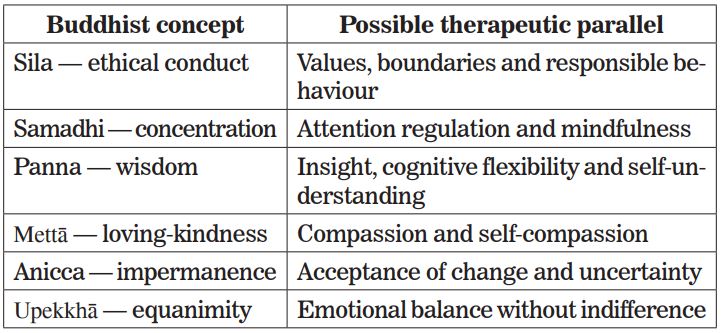
However, important distinctions remain.
Psychotherapy should not become religious instruction. Buddhist teachings should be incorporated only when meaningful and acceptable to the client.
Similarly, therapists must avoid interpreting psychological suffering as punishment for previous Kamma. Such interpretations can reinforce guilt, helplessness or self-blame.
Acceptance of suffering does not mean passive acceptance of abuse, injustice or treatable illness.
4. The therapist’s role in family relationships
Family is central to the lives of many Myanmar people.
The traditional expectation of respecting parents and elders may sometimes create psychological conflicts.
Consider a 28-year-old Myanmar woman whose parents expect her to marry someone they have selected.
She respects her parents but wishes to make her own decision.
Her dilemma is not simply whether to marry. It involves competing values:
• Filial duty versus personal autonomy
• Family harmony versus individual happiness
• Cultural expectations versus personal identity
A culturally sensitive therapist should not automatically encourage rebellion against parental authority or insist upon obedience.
Instead, therapy should help the client understand her values, examine the consequences of available choices and develop appropriate communication and boundaries.
The therapist facilitates informed choice rather than choosing the client.
5. The therapist and emotional suppression
A familiar Myanmar expression is:
အားနာတယ် — Ah Nar Tal
This concept can encompass reluctance to inconvenience others, concern for their feelings, deference and a sense of social obligation.
It is often a positive social quality, encouraging consideration and interpersonal harmony.
However, excessive အားနာခြင်း can create psychological difficulties.
A person may find it difficult to refuse unreasonable requests, communicate dissatisfaction, establish personal boundaries or seek assistance.
Over time, this can contribute to resentment, anxiety, exhaustion and interpersonal difficulties.
A therapist might ask:
“When you say yes to others, are you agreeing because you genuinely wish to help, or because you feel unable to say no?”
Such questions encourage reflection without dismissing the client’s cultural values.
The therapeutic goal is not to eliminate အားနာ ခြင်း, but to help the client distinguish healthy consideration from self-neglect.
6. Authority, hierarchy and the therapeutic relationship
Burmese clients may perceive therapists, particularly medically qualified or older therapists, as authority figures.
This can create an important therapeutic challenge.
A client may agree with the therapist out of politeness rather than genuine conviction. Silence may be mistaken for agreement, and reluctance to ask questions may be interpreted as understanding.
The therapist should actively reduce this power imbalance.
For example:
“You do not have to agree with me. My role is to help you explore your own understanding and decisions.”
The therapist must also maintain professional boundaries. Respect for seniority should never become a justification for paternalism, coercion or excessive dependency.
7. Mental health stigma and confidentiality
In some Myanmar communities, psychological distress is still associated with weakness, family shame or severe mental illness.
Seeking psychiatric or psychological help may therefore be delayed.
A therapist has an important educational role in distinguishing everyday emotional difficulties from diagnosable mental disorders.
Confidentiality is particularly important in close-knit communities where relatives, neighbours and acquaintances may know one another.
Clients need clear explanations of professional confidentiality, its limits and the circumstances in which information may need to be shared for safety or legal reasons.
Therapy should be presented as a legitimate form of healthcare, not evidence of personal or moral failure.
8. Trauma, political conflict and displacement
For Burmese clients affected by political violence, armed conflict, displacement or migration, psychotherapy must extend beyond individual symptoms.
Distress may involve bereavement, survivor guilt, separation from family, loss of livelihood, uncertainty about the future and fear for relatives remaining in Myanmar.
Therapists should avoid treating all such reactions as psychiatric disorders. Some represent understandable responses to extraordinary adversity.
A trauma-informed approach emphasizes safety, trust, choice, collaboration and empowerment.
Where necessary, therapy should also connect clients with practical, social and legal support.
The therapist should recognise that psychological recovery may be difficult when the external source of danger or insecurity continues.
9. Different generations, different therapeutic needs
The expectations of an elderly Myanmar client may differ considerably from those of a young Myanmar professional.
Older generations Younger generations
May place greater emphasis on family duty May place greater emphasis on individual choice
May prefer indirect emotional communication May be more comfortable discussing emotions
May regard therapy as unfamiliar May be more familiar with psychological terminology
May draw heavily on traditional religious or community support
May combine traditional beliefs with contemporary psychological approaches
These are possible patterns, not fixed characteristics. Education, urban or rural upbringing, migration, religion and personal experience can be as influential as age.
The therapist must avoid stereotyping.
10. The therapist’s ethical responsibilities
A culturally competent therapist working with Myanmar clients should maintain several fundamental principles.
Respect: Understand the client’s cultural and religious values without imposing personal beliefs.
Autonomy: Support the client’s right to make informed decisions.
Non-maleficence: Avoid reinforcing guilt, stigma, coercion or harmful family dynamics.
Professional competence: Recognize when specialized assessment, psychiatric treatment or safeguarding intervention is necessary.
Confidentiality: Establish trust through clear professional boundaries.
Cultural humility: Remain open to learning from the client rather than assuming that shared ethnicity or language guarantees understanding.
An especially important distinction is between cultural sensitivity and cultural conformity.
The therapist should understand cultural expectations without automatically endorsing every traditional practice.
11. A philosophical reflection: The therapist is neither a monk nor a judge
In Myanmar society, people traditionally seek guidance from parents, teachers, monks, elders and respected professionals.
Each may provide advice from a particular moral, religious or social perspective.
The therapist occupies a different position.
The therapist is not there to determine who is right or wrong in a family dispute, to preach moral virtue or to prescribe a particular way of life.
Rather, the therapist helps individuals understand their thoughts, emotions, behaviour and relationships.
A Buddhist monk may offer teachings on how suffering can be understood and transcended.
A therapist explores how a particular individual experiences suffering and what psychological, relational or practical changes may alleviate it.
Both may contribute to well-being, but their responsibilities and methods are distinct.
Conclusion: From obedience to understanding, without abandoning respect
The challenge of psychotherapy in Burmese culture is not to replace traditional values with Western individualism.
Nor is it to preserve every cultural tradition regardless of its psychological consequences.
The task is to find a thoughtful balance between respect and autonomy, compassion and boundaries, acceptance and change, family belonging and individual identity.
A therapist should help the client recognize that respecting one’s parents does not require surrendering one’s judgement; that compassion for others need not mean neglecting oneself; and that Buddhist acceptance of impermanence need not mean resignation to avoidable suffering.
Ultimately, the therapist’s greatest contribution may be to create a space in which a Myanmar client can speak freely, question respectfully and make decisions without unnecessary fear, guilt or shame.
A good therapist does not teach the client what to think. A good therapist helps the client discover how to think, feel and choose with greater clarity.
For a professional discussion, I would particularly recommend exploring one further issue: whether the traditional Myanmar culture of advice-giving, respect for elders and moral instruction can sometimes unintentionally turn counselling into paternalism. This is especially relevant when the therapist is also a senior doctor, teacher or respected community elder.
#TheGlobalNewLightOfMyanmar