
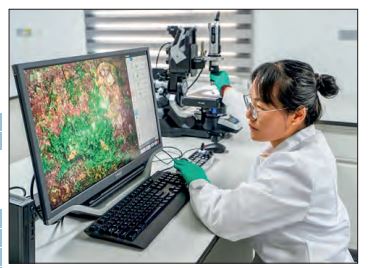
What did ancient people seal in a bronze pot 2,000 years ago? Chinese archaeologists and scientists have jointly confirmed the liquid residue as grain wine of millet and barley from the Warring States Period (475 BC-221 BC), uncovering the mystery quest via cutting-edge technologies.
A well-preserved bronze garlic-head-shaped pot with liquid preserved caught archaeologists’ attention. It was unearthed from a tomb at the Shanjiabu cemetery of the Qin State of the Warring States Period in the city of Guyuan, northwest China’s Ningxia Hui Autonomous Region.
The cemetery is located near the Great Wall built by the Qin State during the Warring States Period, with 183 tombs excavated as of 2024. Though it lacked a cap, the pot’s interior was sealed with textile fabric, and its exterior was coated in a layer of mud blended with organic matter — an ancient double seal that somehow kept a large volume of liquid intact for more than two thousand years.
Using sterile scalpels and tweezers, archaeologists carefully peeled away these seals, collecting roughly 3,740 millilitres of clear, pale bluish-green, odorless liquid and a minor amount of sediment.
Xinhua
#TheGlobalNewLightOfMyanmar