
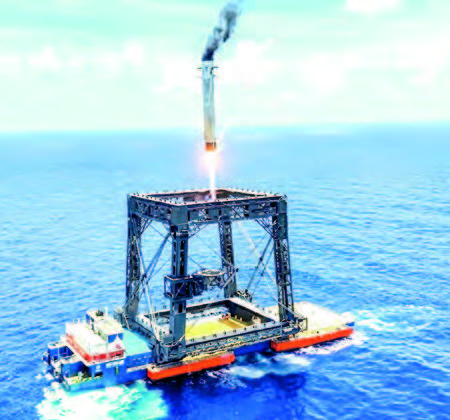
CHINA’S Long March10B rocket, which achieved the successful sea‑based net recovery on Friday, has for the first time used high-purity methane fuel made from liquefied natural gas (LNG), marking a critical breakthrough in diversifying propellant sources for China’s commercial space industry.
The Long March10B is a two-stage reusable commercial launch vehicle developed specifically for China’s commercial space market, with a core-stage diameter of five metres and featuring 100-per-cent domestically produced critical components.
As the country’s first commercial reusable rocket powered by liquid oxygen-methane propellant, the methane fuel used in this launch achieved a purity of 98.7 per cent, with the entire supply chain secured domestically, said the fuel developer, Sinopec, in a report by China Media Group (CMG) on Saturday.
“The methane fuel used in this launch was refined from over 1,000 tonnes of LNG,” said Cao Lizhao, manager of the south China sales center of Sinopec’s natural gas branch.
“The high-purity methane fuel can be processed and prepared using civilian LNG,” Cao noted.
“Compared with traditional liquid hydrogen fuel, this propellant reduces storage and transport costs by 40 per cent, offering a brand-new and viable fuel solution for low-cost, high-frequency commercial launches,” he added.
As China’s commercial space industry rapidly expands, traditional propellants such as liquid oxygen-kerosene and liquid oxygen-liquid hydrogen have struggled to meet the demands of frequent, low-cost missions.
Liquid oxygen-methane propellant, with its superior performance, compatibility with reusable technologies, environmental friendliness, and convenient storage and transport, has emerged as the preferred option for next-generation commercial launch vehicles, according to the CMG report. — Xinhua
#TheGlobalNewLightOfMyanmar