

By Khin Maung Myint
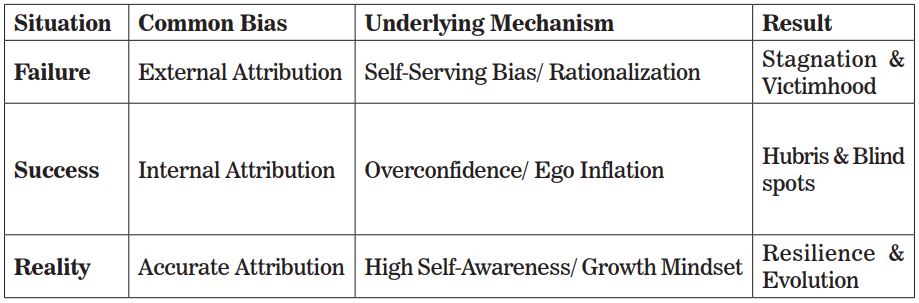
The Failure Pattern: The Self-Serving Bias and External Locus
When someone fails to achieve a goal despite clear evidence of their own role in that failure, they are often employing a Self-Serving Bias. This is a cognitive shortcut that allows the individual to attribute positive events to their own character or actions, while attributing negative events to external, uncontrollable factors.
• External Locus of Control: People who consistently blame “luck”, “God’s will”, or systemic issues (even when those issues are not the primary cause) possess an external locus of control. By placing the cause of the failure outside of themselves, they protect their self-esteem from the painful reality of incompetence or lack of preparation.
• Cognitive Dissonance: The truth — “I failed because I didn’t work hard enough” — is often psychologically painful. To resolve the discomfort (dissonance) between the image of themselves as “capable” and the reality of their failure, the brain constructs a narrative that shifts the blame elsewhere. Blaming “luck” or “fate” is a psychological defence mechanism known as rationalization.
• The Trap of Victimhood: While it is true that discrimination and systemic barriers are real, using them as a blanket shield against self-reflection prevents growth. When an individual adopts an external narrative, they surrender their agency; if you are merely a victim of fate, you have no power to improve your future.
2. The Success Pattern: The Fundamental Attribution Error and Overconfidence
Conversely, when someone succeeds, they often engage in the reverse of the failure bias. They minimize the role of luck, timing, or help from others and inflate their own internal traits.
• The Overconfidence Effect: This occurs when an individual’s subjective confidence in their judgements is reliably greater than the objective accuracy of those judgements. Upon succeeding, they view the result as a direct consequence of their superior intellect or work ethic, ignoring the situational factors (e.g., being in the right place at the right time) that contributed to the win.
•The Fundamental Attribution Error (Self-Directed): We generally judge others by their circumstances and ourselves by our intentions. However, when we succeed, we tend to attribute our success to internal, stable characteristics (intelligence, talent) rather than situational variables. This creates an inflated sense of self-importance or “boasting”.
• Dunning-Kruger Effect: Often, those who boast the most about their achievements lack the metacognitive ability to recognize that their success might have been an anomaly or a result of external systems. They do not realize how much they do not know.
3. The Rare Middle Ground: Reality Acceptance
The individuals you describe as “far and few” — those who are realistic about their successes and failures — are characterized by high levels of Self-Awareness and an Internal Locus of Control.
• Integrity of Self: These individuals have developed a robust self-concept that does not require constant validation through external stories. They can hold the reality of their failure without internalizing it as a flaw in their identity, and they can hold the reality of their success without letting it inflate their ego.
• Growth Mindset: Rooted in Carol Dweck’s research, the growth mindset allows people to view failure as a data point for improvement rather than a threat to their ego. They ask, “What can I change?” rather than “Who can I blame?”
• Radical Acceptance: This is a concept often used in Dialectical Behaviour Therapy (DBT). It is the practice of accepting reality exactly as it is, without judgement or attempt to change the narrative. It doesn’t mean liking the situation; it means acknowledging it so that one can respond effectively.
Summary Table: The Psychological Spectrum
Final Reflection
The reason these behaviours are so common is that ego-protection is a powerful instinct. It is easier to live in a world of “bad luck” or “self-made genius” than to sit with the vulnerability of being an imperfect human in a complex, often random world. The “realistic” few are not necessarily more talented; they are simply more willing to bear the discomfort of the truth.
In the Buddhist view, the person who blames the world for their failure and the person who boasts of their success are actually suffering from the same malady: the inability to let go of the “I”.
To stop blaming and to stop boasting is not merely a social nicety; it is a spiritual practice. It is the recognition that when you stop trying to build a fortress around your ego, you finally become free to move through the world with truth, clarity, and peace.
Summary Table: The Psychological Spectrum
#GlobalNewLightOfMyanmar