Atul Aneja
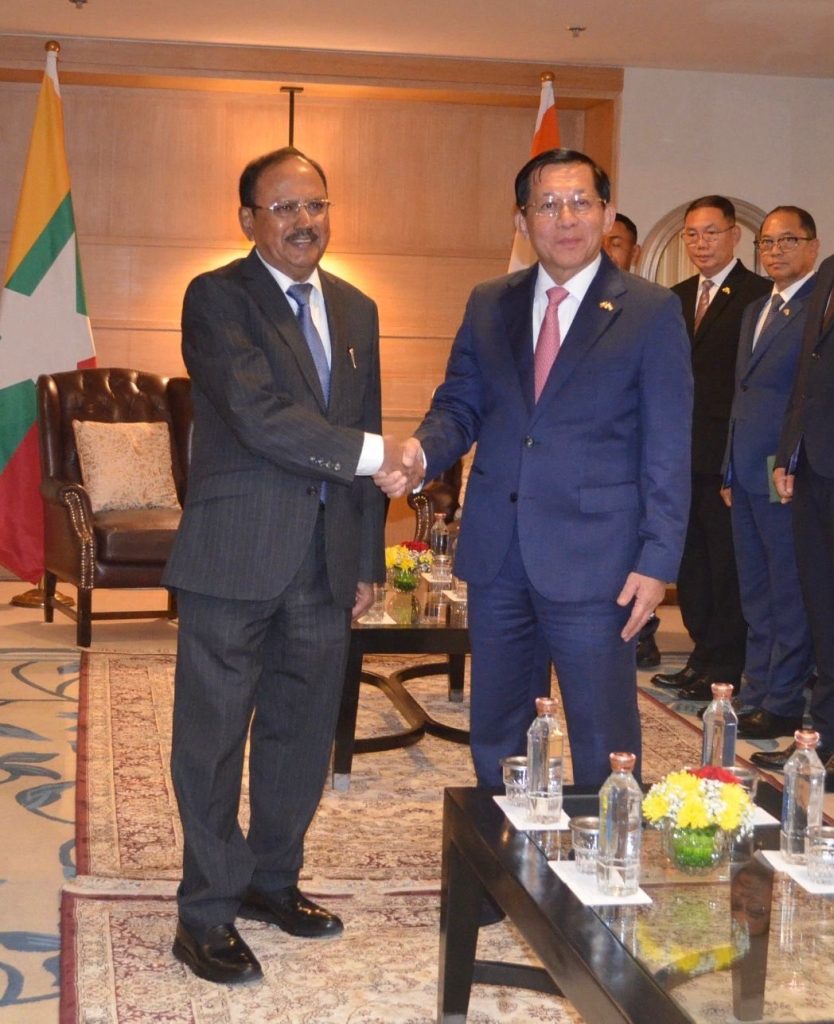
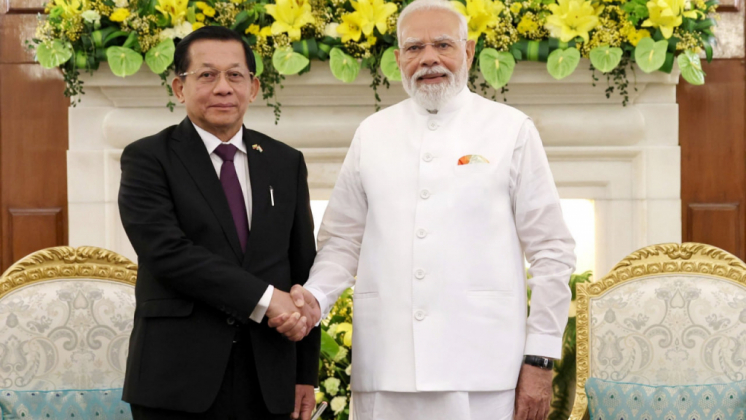
Myanmar’s President Min Aung Hlaing is in the middle of a visit to India–his first port of call after the country concluded its national elections in January this year.
Much of the strategic commentary is framing the President’s visit to New Delhi as a balancing act between India and China.
Nothing could be farther than the truth. Sanctioned by the United States and Europe, with brief intervals of relaxations, during the unipolar era, Myanmar’s problems are with the West and not with its two giant neighbours- India and China.
On the contrary, the problem that has endured has been with the collective West, which, for decades sought to sideline the military or the Tatmadaw from governance, by engineering a pro-democracy campaign spearheaded by Aung San Suu Kyi and a full ecosystem of international NGOs, foreign funded media and human rights campaigners and other fifth columnists. The opposition had been liberally funded by organisations such as the United States Agency for International Development (USAID) and the National Endowment for Democracy (NED).
Faced with an existential threat, the Myanmar government opened lifelines with the non-western world, principally China, India and Russia.
In forging strategic ties with the Russia-India-China or the RIC core of the emerging economies, Myanmar was guided by an astute understanding of rapidly changing world order. Myanmar’s Generals understood that the unipolar “end of history” moment had passed.
Instead, a multipolar world, anchored by the RIC, was emerging. It was to this troika that Naypyidaw had to pivot.
It was therefore not surprising that after the 2021 military takeover, which took place after the invocation of the emergency provisions of the 2008 constitution, former Senior General Min Aung Hlaing paid two crucial visits to China.
In November 2024, he visited Kunming, in China’s Yunnan province, where he attended the 8th Greater Mekong Subregion Summit and met Premier Li Qiang, signing MoUs on agriculture, science, and technology.
In August–September 2025, he visited Tianjin, Beijing, Harbin and Chengdu.
In Tianjin, Mi Aung Hlaing attended the summit of the Shanghai Cooperation Organisation (SCO). Soon after he witnessed the WWII Victory Day parade, occupying a vantage position in Beijing’s famous Tiananmen Square.
During his outing in Tianjin, Min Aung Hlaing also met Indian Prime Minister Narendra Modi, who is currently hosting him in New Delhi.
In his earlier Avatar as senior General, Min Aung Hlaing has paid five visits to Russia– an open demonstration of special ties between Napyidaw and Moscow. It is therefore not surprising that during their meeting in the Kremlin in March last year, Russian President Vladimir Putin stressed that not only are Russia-Myanmar ties “steadily developing,” there is also a “great potential” for the furtherance of ties. Putin spotlighted that Russia has been a crucial arms supplier and a reliable economic partner of Myanmar–a remark that was coded in a joint statement that reaffirmed “strong ties of friendship, tradition, support and mutual assistance” between the two countries.
More specifically, the visit yielded an agreement, whereby Russia would build a low-power nuclear power plant in Myanmar.
In order to reinforce its RIC pivot, Myanmar has been relentlessly pushing for an entry into two critical non-western platforms–theBrazil-Russia-India-China-South Africa (BRICS) grouping of the emerging powers as well as the Eurasia centred SCO, which also has Russia, India and China as its partnering countries.
Unsurprisingly, Myanmar is also seeking a deeper engagement with the Russia-centered Eurasian Economic Union (EEU).
In view its bigger strategic imagination of establishing non-western lifelines, it would be in Myanmar’s interest to play a bridge-building role between India and China in order to structurally reinforce its pivot towards New Delhi, Beijing and Moscow, in order to withstand the hostility of the globalist West, which may have temporarily abated but not disappeared, instead of exploiting India-China rivalry.
In order to cement its ties with China and India, Myanmar is leveraging its location as a land bridge between the two rising powers, as well as Thailand. This is being done by focusing on three strategic connectivity projects.
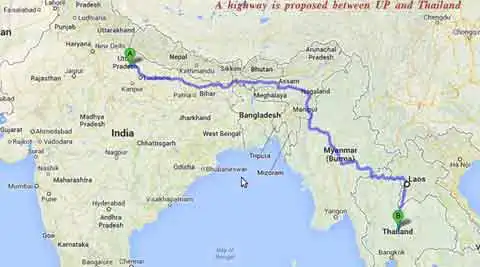
Geographically and circumstantially, Myanmar is well positioned to develop the East-West transportation spine that will link India with the Pacific coast. This will happen once the India–Myanmar–Thailand Trilateral Highway (IMTT-H) is fully developed. Conceived at a trilateral ministerial meeting in Yangon in April 2002, the project envisions a roughly 1,360-kilometer road corridor.
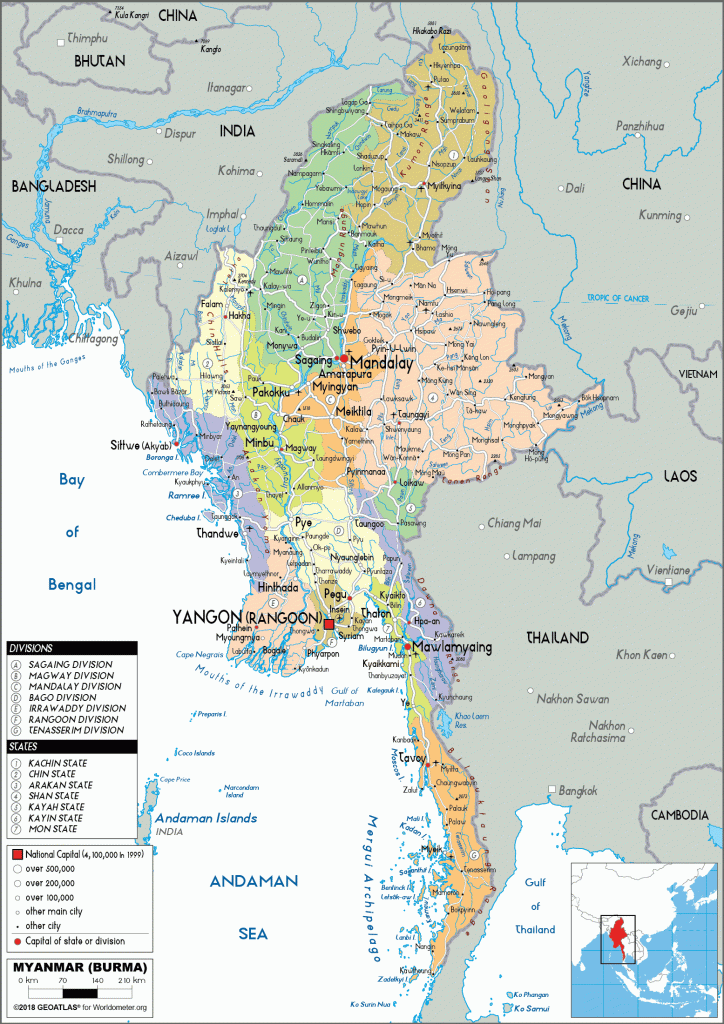
Starting from Moreh in India’s Manipur state, it cuts across the Sagaing region
and northern Myanmar, down through Bagan to Mandalay, and then eastward via Myawaddy to Mae Sot in Thailand and onward to Bangkok. For India, the highway has always been the flagship of its Act East policy. In fact, it is seen as a physical expression of the underlying thought that the country’s north-east is not a peripheral land-locked appendage but a gateway to Asia.
The Northeast should indeed be an economic pivot that can transit Indian goods, services and people from Imphal the capital of the state of Manipur to Bangkok.
Two decades after its conception, the highway is roughly seventy percent complete. India is constructing about 200 kilometers of the alignment, including the upgrading of 69 bridges originally built during the Second World War. Thailand is responsible for roughly 30 kilometers of construction plus a major bridge at the Myawaddy-Mae Sot crossing, a section that was completed in July 2021 and is now fully operational.
Despite the progress, the most stubborn bottleneck is the 121-kilometre Kalewa-Yagyi stretch in the Sagaing region of Myanmar, for which India agreed to fund construction at a cost of roughly $123 million. Myanmar authorities have indicated that converting this portion of the road into a four-lane motorway will require more time than anticipated, given the persistent security situation in the Chin State and Sagaing Region, both of which remain conflict zones.
Given the bottlenecks, the current target for full operationalisation has slipped from 2015 to 2019 to 2023 and is now set at 2027.
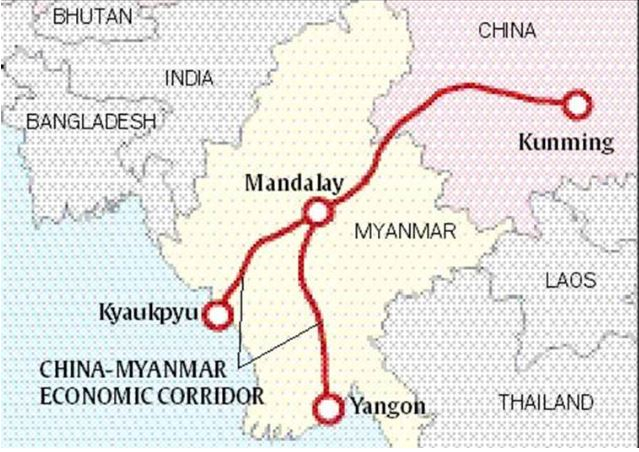
While the ATH is the East-West connectivity spine, the China Myanmar Economic Corridor (CMEC) is the North-South connectivity spine, which was green-lighted in 2017, and codified in a fifteen-point Memorandum of Understanding in 2018.
It is evident that CMEC is the most ambitious of the corridor proposals currently in play. Geographically, the corridor will be carving southwards, a new rail axis from China’s Yunnan province to Mandalay, the cultural and spiritual heartbeat of Myanmar — often described as a forest of temples.
Kyaukphyu is the maritime terminus of the China-Myanmar oil and gas pipelines, which have been operational since 2013-17 and which deliver West Asian hydrocarbons to refineries in Yunnan and Chongqing.
The corridor has four load-bearing components. The Muse-Mandalay railway, a 431-kilometre standard gauge line, is the first. A feasibility study for this segment was completed in 2018. This was followed by a framework agreement, which was signed in 2020.
Second, the Mandalay-Kyaukphyu railway, has been conceived as the continuation of the Muse line to the coast by drawing Mandalay as a major railway hub in Myanmar’s center,
As a result, the total Kunming-to-the-Sea axis will extend to 1,700 kilometers.
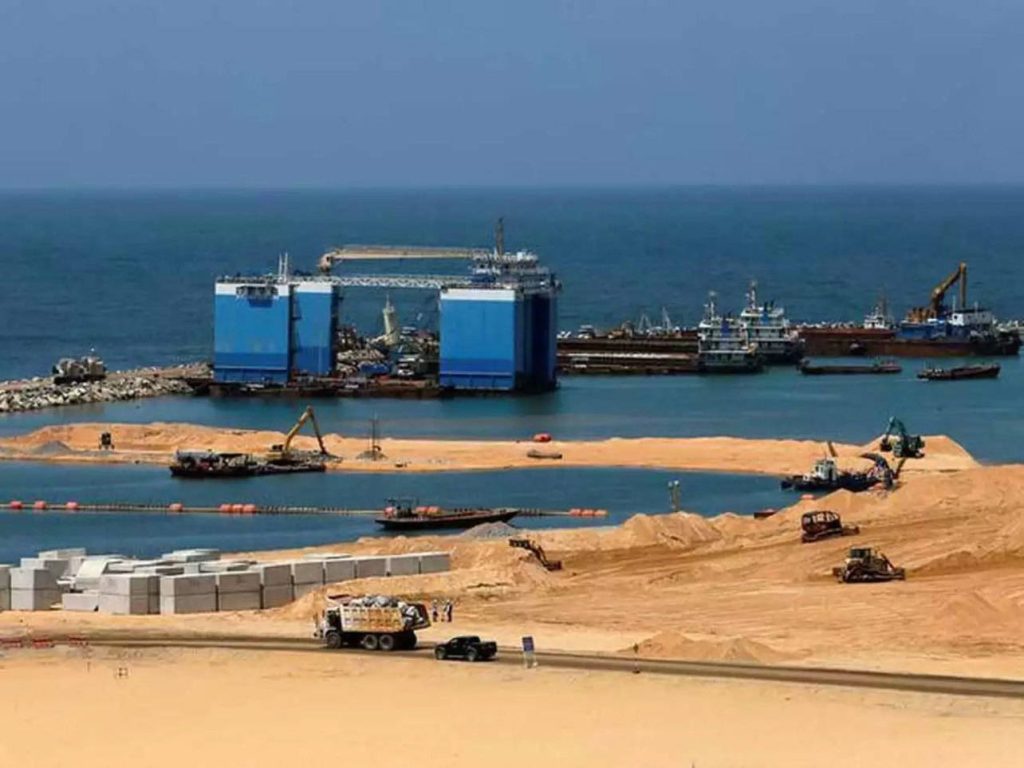
Third, the Kyaukphyu deep-sea port and adjacent special economic zone was to originally cost $7.3 billion. But later, Myanmar fearing a debt trap scaled it down to roughly $1.3 billion.
Fourth, the existing oil and gas pipelines are already helping China with a limited Malacca-bypass option.
For nearly a decade, the Kyaukphyu deep-sea port has been under intermittent construction, but has not reached its target of 40,000-tonne-vessels. The Muse-Mandalay exists mostly on paper.
Yet, the strategic logic of the building CMEC has not weakened. On the contrary, the 2023 Red Sea crisis, impeding Suez Canal trade, has only hardened the compelling logic of going ahead with the CMEC project, before sea lanes enter the US dominated Malacca straits.
After the latest elections, the new government is in a good position to re-imagine its connectivity framework, in a manner that would also draw Russia and broader Eurasia into it.
The key nodes are Mandalay and Kunming. While the Chinese have already stated their intent to build a CMEC railway, India too is reportedly considering extending its railway from its northeast to Mandalay, more or less along the ATH alignment up to this city.
In fact, Mandalay becomes the junction where the ATH and CMEC extend.
Once the CMEC railway from Kyaukphu via Mandalay reaches Kunming, it opens a pathway to connect Myanmar, and potentially India to the broader Eurasian region including Russia.
The Kunming junction is a major Eurasian connectivity fulcrum. As part of the Chinese national railway network, Kunming is well-integrated with Beijing through high-capacity passenger and freight lines. From Beijing, three legacy international corridors radiate outward into Eurasia. Train K3/K4, running weekly, departs Beijing for Ulaanbaatar in Mongolia and continues onward to Moscow, in what is conventionally called the trans-Mongolian route. This route links up with the Vladivostok-to-Moscow Trans-Siberian Railway at the Russian city of Ulan-Ude, completing the longest single passenger rail journey in the world.
The trans-Mongolian line itself was completed in 1956 and at the time united the two great communist powers — the Soviet Union and China — with resource-rich Mongolia as a buffer in between.
A second corridor, the trans-Manchurian, is served by train K19/K20, running once a week from Beijing and terminating at Moscow. The trans-Manchurian line connects to the Trans-Siberian Railway at Chita, east of Lake Baikal. Built by imperial Russia between 1897 and 1902, it was a geopolitical flashpoint during the Russo-Japanese War of 1905 and again during the Japanese occupation of Manchuria in the 1930s and 1940s. Today it carries primarily freight, including containerised exports from Chinese industrial centers bound for European markets via the Russian rail gauge.
China also operates direct services to Vladivostok and to Ulan-Ude, which is famous for its remarkable mix of Russian Orthodox, Buddhist and shamanic traditions and which sits at the convergence point of the trans-Mongolian and trans-Manchurian systems on the Trans-Siberian mainline.
These connectivity projects, if completed, will firmly cement the RIC connectivity architecture, providing Myanmar fool-proof insulation from any western pressures now, or in the future. This would also be a major contribution to the consolidation of multipolarity threading the three civilization pivots of the new world order–Russia, India and China.
When President Min Aung Hlaing departs from India, he may have no choice but to remove a major internal obstacle to these projects. Myanmar’s geo-economic aspiration can be fulfilled only if there is peace at home. And for a peace dividend to accrue, an internal reconciliation process that would end the country’s chronic insurgencies is indispensable.
How should that be accomplished? Though, for historical reasons and errors of judgement, this would not easy, the Myanmar government, nevertheless, can explore one potent pathway. Without budging from the 2008 constitution, it might like to explore its under-exploited federative attributes.
For instance, section 56 of the 2008 Constitution establishes six Self-Administered Areas: five Self-Administered Zones (for the Naga, Danu, Pa-O, Pa-Laung, and Kokang) and one Self-Administered Division (for the Wa). Each has its own Leading Body, its own elected representatives, and authority over a specified list of subjects under Schedule III of the constitution.
Besides, the 2008 Constitution’s Schedule II enumerates subjects on which Region or State legislatures can have their own laws. These include development matters; agricultural production; livestock; freshwater fisheries; salt and salt products; municipal affairs and town planning; water, electricity, and roads within state boundaries; local taxation; cultural and educational matters at the state level; and a residual category covering matters not enumerated in the Union List. In practice, these competences have been weakly exercised because state legislatures have lacked technical capacity and because Union ministries have crowded into nominally state-level subjects.
A credible peace offer could promise robust devolution of Schedule II matters in practice, with associated fiscal transfers, technical assistance, and a moratorium on Union ministerial overreach. This would not amend the constitution but would substantially change how it operates.
If the new government can sort out national reconciliation, this would open a clear path for Myanmar to emerge as a Middle power in partnership with the RIC.
#geopolitika.ru