

WHEN TV cameras captured Yu Yanqia, 8, dragging herself upside down along a steel rope strung above the raging Nujiang River on her daily journey to school, no bridges spanned the Nujiang, in rural Fugong county, Yunnan province. So the only way anyone could cross the river was the primitive and precarious steel rope and pulley system that Yu used that day in 2007.
Since then things have vastly improved for Yu and the area in which she lives.
Yu, now a doctor at a hospital in Nujiang Lisu autonomous prefecture, in which Fugong county is situated, remembers how her heart raced with the howling wind each time she crossed the river.
“I’d never been far from my village, so I just thought everyone used pulley bridges to cross rivers,” she told Chinese media in July.
The images seen nationally of her crossing the river spurred action to build a bridge across the Nujiang, and when it was completed the following year Yu was chosen as the first person to cross it.
Yu’s story encapsulates the rapid progress that has been made in China in improving infrastructure and lifting people out of poverty, especially in remote parts of the country.
Twenty years ago Fugong had some of the most entrenched poverty in the country, with more than half of its people being impoverished. Yunnan had the highest number of poverty-stricken counties in the country, totalling 88.
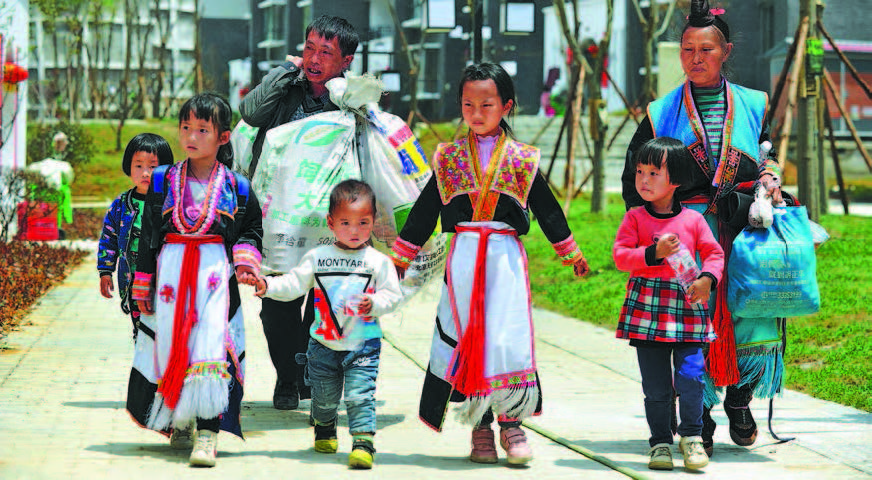
Today villages are linked by paved roads, and bridges span rivers, meaning that communication, the flow of people and commerce have greatly improved. Access to education, healthcare, work and daily necessities has also improved.
Since the People’s Republic of China was founded in 1949 the battle against poverty has been a top priority for the Communist Party of China. Following the 18th CPC National Congress in 2012, central authorities stepped up efforts to eliminate rural poverty, setting a goal of eradicating poverty before the Party’s centenary in 2021.
A key aspect of this campaign has been improving rural connectivity.
By 2016 all pulley bridges in Nujiang prefecture had been replaced by modern bridges. Today these bridges along the Nujiang River, rather than just being transportation channels, have also become tourist attractions.
Since the 18th CPC National Congress, China has built or rebuilt more than 2.53 million kilometres of rural roads and built paved roads in 1,040 townships and 105,000 villages, according to official figures.
More than 50,000 villages have also been connected by passenger bus services.
Nearly 100 million rural poor escaped poverty between 2012 and 2021, ending domestic poverty on the Chinese mainland.
This achievement is all the more remarkable given the global trend of rising poverty.
The World Bank said 712 million people worldwide were living in extreme poverty in 2022, 23 million more than in 2019.
The pandemic significantly hampered global poverty reduction efforts, leading to three years of setbacks, between 2020 and 2022, affecting low-income countries in particular.
Before National Poverty Relief Day on 17 October four years ago, Guy Ryder, then director-general of the International Labour Organization, said China’s decision to stick to the goal of eradicating rural poverty by the end of 2020 amid a “complex economic environment” set a benchmark in meeting the United Nations 2030 Sustainable Development Goals, which include eliminating extreme poverty worldwide in a decade.
On 25 February, 2021, at a conference in Beijing, President Xi Jinping announced that China had achieved complete victory over absolute poverty, with a total of 98.99 million rural poor having been lifted out of poverty.
“China has completed the task of eradicating absolute poverty, which is truly a miracle of human society,” said Zhang Jun, then China’s permanent representative to the UN, in 2021.
The country’s achievement in eliminating poverty was an important contribution to global human rights, he said.
The number of Chinese who escaped poverty over the past 40 years has accounted for more than 70 per cent of the world’s impoverished people during that period, measured by the poverty threshold set by the World Bank.
# The Global New Light of Myanmar