
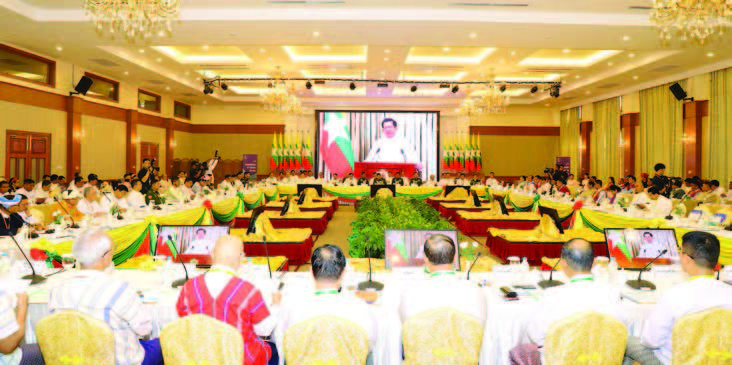
THE 11th Anniversary Ceremony of the Nationwide Ceasefire Agreement (NCA) was held yesterday morning at the Horizon Lake View Hotel in Nay Pyi Taw, with President U Min Aung Hlaing of the Republic of the Union of Myanmar delivering an opening address via a video message. (The President’s opening address is published separately.)
Union Minister for Defence NSPNC Chairman Lt-Gen Yar Pyae delivered remarks marking the 11th anniversary of the NCA.
A video clip summarizing the peace efforts of successive governments and ongoing endeavours to achieve sustainable and lasting peace following the signing of the NCA was then screened.
Representatives of China, India and Thailand who witnessed the original signing of the NCA subsequently delivered commemorative messages via video.
Commemorative remarks were also delivered by peace process contributors and NCA witnesses, including Kayin ethnic leader Saw Mutu Sae Poe, retired Union Minister and former Vice-Chairman of the Union Peacemaking Work Committee (UPWC) U Aung Min, who heads the NSPNC Advisory Group, and retired Union Minister and former UPWC Vice-Chairman U Thein Zaw, a member of the NSPNC Advisory Group.
Leaders of NCA-signatory ethnic armed organizations, including the ALP, DKBA, KNU/KNLA-PC, LDU, NMSP and RCSS, subsequently delivered commemorative speeches marking the anniversary.
Following the speeches, commemorative gifts marking the 11th anniversary of the NCA were presented to individuals who had contributed to the signing of the agreement, its original signatories, key supporters of the peace process and leaders of ethnic armed organizations. The ceremony concluded with a group photo session, followed by an official luncheon.
In the afternoon, the workshop themed “From Peace and Social Harmony to Development”, held to commemorate the 11th anniversary of the Nationwide Ceasefire Agreement (NCA), continued.
In his remarks, NSPNC Chairman Lt-Gen Yar Pyae said the two-day workshop was being held under the theme “From Peace and Social Harmony to Development” to facilitate substantive discussions on political issues. He explained that the first day’s discussions would focus on “Reviewing Experiences, Achievements and Challenges of the NCA to Identify Approaches for Future Peace Processes”. On the second day, participants would be divided into two groups. Group 1 would discuss “Identifying and Studying Practical Ways to Collaborate for Peace, Stability and Social Harmony in Conflict-Affected Areas,” while Group 2 would discuss “Identifying Interconnected Approaches Between Peace, Regional Economic Development and Sustainable Livelihood Opportunities, and Effectively Delivering Humanitarian Assistance and Addressing Needs”. He encouraged participants to engage in open, broad-based and informal discussions by sharing implementation experiences, achievements, lessons learned and different perspectives. He emphasized that social harmony must be fostered in the Union, where diverse ethnic groups, languages, faiths and cultural traditions coexist, to overcome suspicion, which he identified as a primary cause of conflict. He added that peace stakeholders needed to remain mindful of existing challenges and potential future threats while strengthening mutual trust and cooperation.
Afterwards, peace process contributors, representatives of ethnic armed organizations, delegates from the political parties’ working group and other invitees attended a session on “Reviewing Experiences, Achievements and Challenges of the NCA to Identify Approaches for Future Peace Processes.” The session was chaired by U Aung Naing Oo, with retired Lt-Gen Khin Zaw Oo, U Hla Maung Shwe and Sao Sai Ngin of the Restoration Council of Shan State (RCSS) serving as lead discussants.
During the session, participants openly exchanged views on lessons learned from implementing the peace process in accordance with the NCA, preserving the agreement’s essence and fundamental principles while conducting negotiations in line with current conditions, building trust through reliable and mutually accepted channels to foster good relationships among diverse stakeholders, and conducting political dialogue to rebuild trust.
Following the discussions, the workshop chairman delivered a concluding review, bringing the first day’s proceedings to a close. The second day of the workshop is scheduled to continue on 16 October.
MNA/TH
#TheGlobalNewLightOfMyanmar