
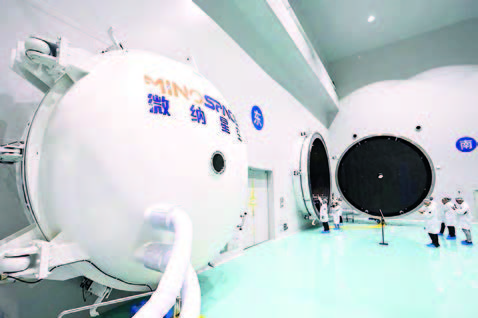
INSIDE a dust-free, noisefree smart workshop beside Taihu Lake in east China’s Jiangsu Province, technicians in anti-static suits assemble satellites on automated production lines. Home to Jiangsu’s largest and most intelligent satellite mass-production base with a total investment of 1 billion yuan (about US$147 million), Guoyu Starry Sky Technology Co Ltd in the city of Wuxi, a fully-owned subsidiary of Beijing Minospace Technology, can churn out more than 150 satellites annually.
The satellites each weigh 200 to 500 kilogrammes, covering optical remote sensing, SAR radar, low-orbit communication and navigation enhancement models. “Previously, developing a customized satellite took three to six months. On our flexible production line, a mass-produced satellite can be finished in merely 20 to 25 days,” said Shi Changfu, deputy general manager of Guoyu Starry Sky.
Robotic arms installed along the production frames automatically apply thermal conductive grease and mount precision components, boosting assembly accuracy and efficiency.
The whole plant runs on an integrated intelligent system empowered by AI and digital twin technology, separating satellite platforms from mission payloads like a smartphone body matching different apps. Different types of satellites can be manufactured on one single line without full redesign.
A full set of space environment simulation test equipment stands beside the assembly area, including huge thermal vacuum chambers and mechanical vibration tables. Every satellite undergoes rigorous tests to replicate extreme temperature, vibration and electromagnetic conditions in orbit.
SAR satellites manufactured here can detect millimetre-level ground deformation around the clock, supporting disaster prevention, geological monitoring and urban management, according to on-site engineers. A milestone came on 13 June, when six Huantian Constellation satellites rolled off the production line, including four SAR radar satellites and two optical satellites. — Xinhua