
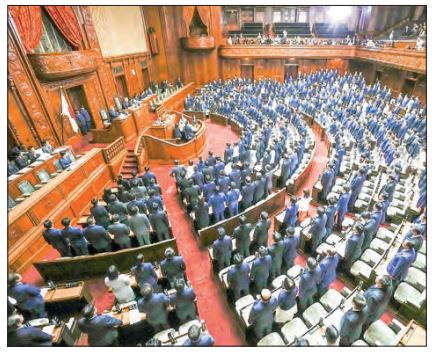
THE House of Representatives on Friday passed a bill for a law revision to address the dwindling number of imperial family members after entering deliberations earlier in the day, a major step to change Japan’s decades-long system.
Following the lower chamber’s approval, the ruling Liberal Democratic Party and its junior coalition ally, the Japan Innovation Party, aim to pass the legislation through the House of Councillors for its enactment during the current parliamentary session through 17 July. In a vote hours after discussions started, the bill for the first substantial amendment of the 1947 Imperial House Law was backed by the ruling camp that holds more than twothirds of the lower chamber’s seats, a threshold required to override the upper house when pushing through bills.
Prime Minister Sanae Takaichi’s government submitted the bill late last month, but a parliamentary stalemate stemming from opposition forces’ backlash against what they say is the ruling bloc’s high-handed approach to other key legislations had prevented debates from starting. The bill’s two pillars are to permit the imperial family to adopt males aged 15 or older who are descended from emperors through the male line in 11 former branch families, and also allow female members to retain their imperial status even after marrying commoners. While banning adopted members themselves from becoming emperor, the legislation would allow their male descendants to be eligible to ascend the Chrysanthemum Throne.
Still, it did not mention the idea of female or maternal-line emperors that has garnered public support. Under the current law, only males who have an emperor on their father’s side can ascend the throne, while female members lose their imperial status upon marriage. Both the number of eligible successors and that of the imperial family members have been declining.
Kyodo
#TheGlobalNewLightOfMyanmar