
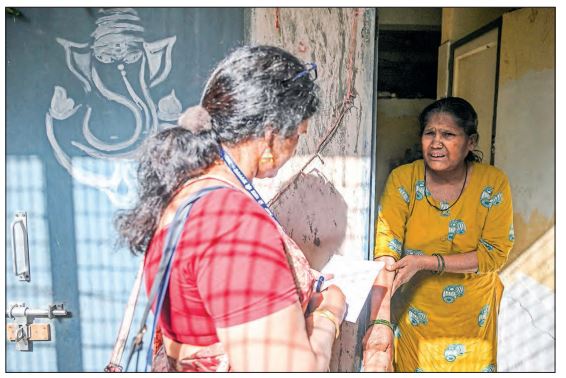
SUKHWINDER Kaur battles the scorching sun as she trudges door-to-door in New Delhi as part of India’s colossal exercise to count more than one billion citizens. Kaur is among three million census enumerators fanning out across cities and villages in an exercise that will help shape policy for the country’s estimated 1.4 billion people for years to come.
Billed as the world’s largest population count, the census is being held in two phases at a cost of $1.25 billion, according to the government. Last week, the heat became overwhelming for Kaur, a government school teacher. “I went back home, but returned again in the evening,” said Kaur, who will be paid 25,000 rupees ($270) for the assignment, like other census enumerators.
Feebly knocking on a door in the servants’ quarters of an upscale housing society, Kaur, 38, tried to explain the purpose of her visit to an elderly resident. “Because we have been handling children, we have, in a way, learned how to deal with all kinds of people,” she said. “Some speak politely, some behave strangely but we know how to handle them.” In the first phase, census takers ask 33 questions related to water, sanitation, electricity, cooking fuel and internet.
The second phase next year will focus on economic status as well as the more contentious question of caste — the millennia-old social hierarchy that is deeply entwined with Indian politics and welfare entitlements. As in the past, census results will be released in phases starting late next year. The Hindu-majority nation faces mounting challenges in providing housing, electricity and other basic needs to its growing population.
Many of its megacities are already grappling with water shortages and overcrowded slums. The government says the first phase “forms an essential foundation for evidence-based planning and formulation of welfare and development programmes.”
AFP
#TheGlobalNewLightOfMyanmar