
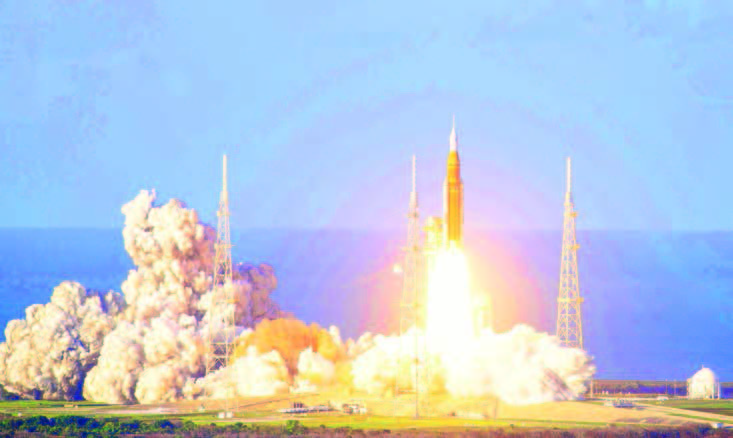
A US spacecraft carrying four astronauts was launched Wednesday for a flight around the Moon in the first manned lunar exploration since the Apollo era half a century ago.
The astronauts of NASA’s Artemis II mission are scheduled to fly on the Orion spaceship for around 10 days, passing the Moon some 380,000 kilometres away before circling its far side and returning to Earth.
As the four — three Americans and one Canadian — are set to travel far beyond the Moon as part of the flight path, they are likely to surpass the current deepspace record for any human, made by the crew of Apollo 13 as it ventured some 400,000 kilometres away from Earth in 1970.
The Orion spacecraft, atop a 98-metre-tall Space Launch System rocket, took off from Kennedy Space Centre in Cape Canaveral, Florida, late Wednesday afternoon.
According to the National Aeronautics and Space Administration, Orion will spend approximately four days travelling to the Moon after circling Earth twice, during which the crew will test equipment and adjust its trajectory.
While circling behind the Moon, the spacecraft will change its trajectory toward Earth using lunar gravity, and spend around another four days travelling back home. It will splash down in the Pacific Ocean. Humankind last landed on the Moon in 1972, with Apollo 17. — Kyodo
#TheGlobalNewLightOfMyanmar