Atul Aneja
Young men and women, dressed in their traditional attire—are busy preparing to meet the December 28 deadline, when the first phase of national elections begins. The entire balloting must be completed by January end. After that the parliament will get into business, and a new government will take charge, with the intent of steering Myanmar towards a brighter future.
But challenges abound, though there is optimism that the worst is over, and the elections will lead to an unprecedented transition– in fact, a historic new beginning that will give this frontier state, a bridge between China and India, a second chance to shape its destiny.
The upcoming polls could be an important turning point, as with these elections Myanmar is once again making another attempt to transition towards democracy, which the military had to interrupt in 2021, after controversial polls were held a year earlier, which were mired by credible allegations of electoral fraud and much more. In some sections of Myanmar’s punditry, the upcoming elections are being compared to what transpired in 2010, when Myanmar once again returned to democracy. That transition was based on the 2008 constitution—the basic law that will continue to guide the upcoming polls.
The next elections are being held at a time when the security situation in Myanmar has palpably improved. In the north, the military has made some significant gains. Apart from heavy combat, deft diplomacy has played its part to diminish the violence. In response to the serious attempt at regime change by the West following the military takeover in February 2021, Myanmar authorities, under the stewardship of Acting President Min Aung Lai, have fundamentally transformed Myanmar’s diplomatic orientation. Discarding its earlier default position of wooing the US and its Asian constellation—the 10-nation ASEAN, Japan, and South Korea—Myanmar under Senior General Min Aung Lai has aligned the pivotal state—the bridge between South and Southeast Asia–to new multipolar realities of the international system.
Under the stewardship of the Acting President, neighbourhood first has become Myanmar’s new foreign policy mantra. That has meant forging special ties with China and India, Myanmar’s two neighbouring civilizational states. When it comes to advanced weaponry, the leadership in Naypyidaw has sought special ties with Russia. This was evident in Gen. Min Aung Hlaing’s engagements abroad. In tune with Myanmar’s foreign policy pivot, in the face of devastating western economic sanctions, the Acting President has met President Putin on at least four occasions.
In June 2021, the two leaders bonded at the International Security Conference in Moscow, a few months after the military takeover. The relationship warmed up after the duo met again, a year later, at the military technology expo in Russia. Unsurprisingly, this led to a deeper relationship in the military and energy fields.
The spiralling Myanmar-Russia ties appeared to have touched a new high on March 4 this year when Putin received the Acting President at the Kremlin. The visit led to signing of 10 MoUs covering nuclear energy, education, sports, and trade.
While Russia has been the top supplier to Myanmar of aircraft, radars and more, the nuclear energy partnership has added a qualitatively new dimension to their relationship. In March this year, the two countries signed a series of agreements to develop Small Modular Reactor (SMR) technology in Myanmar. Under the framework agreements, Russia will help build a 110 MW small modular reactor in Myanmar, with potential expansion to 330 MW. The reactor will use Russia’s RITM-200 pressurized water reactor, a compact design used in Arctic icebreakers. A memorandum on nuclear and radiation safety was signed to ensure regulatory standards.
With the West going all out to engineer regime change by fuelling armed conflict with the State, Myanmar has responded by forging strategic ties with China. Myanmar’s Acting President has twice this year met Chinese President Xi Jinping. The first meeting took place on May 9 in Moscow when Gen. Min Aung Hlaing joined Xi and Putin to celebrate the 80th anniversary of Moscow’s victory in the second world war.
But more significantly, Myanmar’s leader held a formal bilateral meeting with President Xi on August 30 at Tianjin on the sidelines of the Shanghai Cooperation Organisation (SCO) summit. That event formalised strategic ties between Myanmar and China.
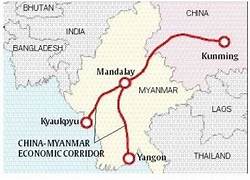
In doing so, China fully recognised the current government as its main partner in advancing Beijing’s core interests. This has included the establishment of the China Myanmar Economic Corridor (CMEC). China has invested hugely in CMEC as it is part of its broader maritime strategy in the Indian Ocean. Wary of Washington’s overwhelming control over the strait of Malacca, the key trade artery linking the Indian and the Pacific Oceans, China has been working feverishly to lower its reliance on this channel. Consequently, it has built Gwadar, a key port in the Arabian sea as part of the China Pakistan Economic Corridor (CPEC). Under CMEC, it is developing the deep-water Bay of Bengal port of Kyaukphyu. Already from Kyaukphyu a twin oil and gas pipeline is transferring energy to China’s Yunnan province, thus lowering Beijing’s reliance on Malacca strait for energy transit.
Unsurprisingly, during the Tianjin meeting with the Acting President, China reaffirmed support for the Kyaukphyu deep-sea port project and the CMEC.
Equally significantly, China decided to halt support for ethnic insurgencies, including key elements of the Brotherhood Alliance. The Brotherhood alliance comprising the Myanmar National Democratic Alliance Army (MNDAA), the Ta’ang National Liberation Army (TNLA) and the Arakan Army (AA) launched coordinated attacks against Myanmar security forces in October 2023. But opposed to the collapse of the state, China has successfully restrained most of these groups, which could, otherwise have obstructed the CMEC route.
In January China brokered a ceasefire between the military and (MNDAA), which mainly comprises the ethnic Kokang group that has close ties with Beijing. Similarly, the Myanmar military has recently made impressive gains in the north against the TNLA.
Besides, the Chinese have reportedly curbed the United Wah State Army (UWSA) that has strong ethnic, military, and economic ties with China.
Consequently, the Myanmar military is gradually tightening its grip along most of the north-south CMEC route, thereby helping China achieve its core strategic objective.
Myanmar’s current government has also been working hard to consolidate ties with India at a fundamental level.
Gen. Min Aung Hlaing met Indian Prime Minister Narendra Modi in April in Bangkok on the sidelines of the Bay of Bengal Initiative for Multi-Sectoral and Technical Cooperation (BIMSTEC) grouping. The two leaders met again in August in Tianjin on the sidelines of the SCO summit. India’s first responder humanitarian assistance following Myanmar’s devastating earthquake on March 28 had by now added a new element of goodwill between the two countries, whose ties go back to antiquity.
In reinforcing its relationship with India, Myanmar is keen to add strategic cement by completing two major projects: the Kaladan project and the Asian Trilateral Highway (ATH).
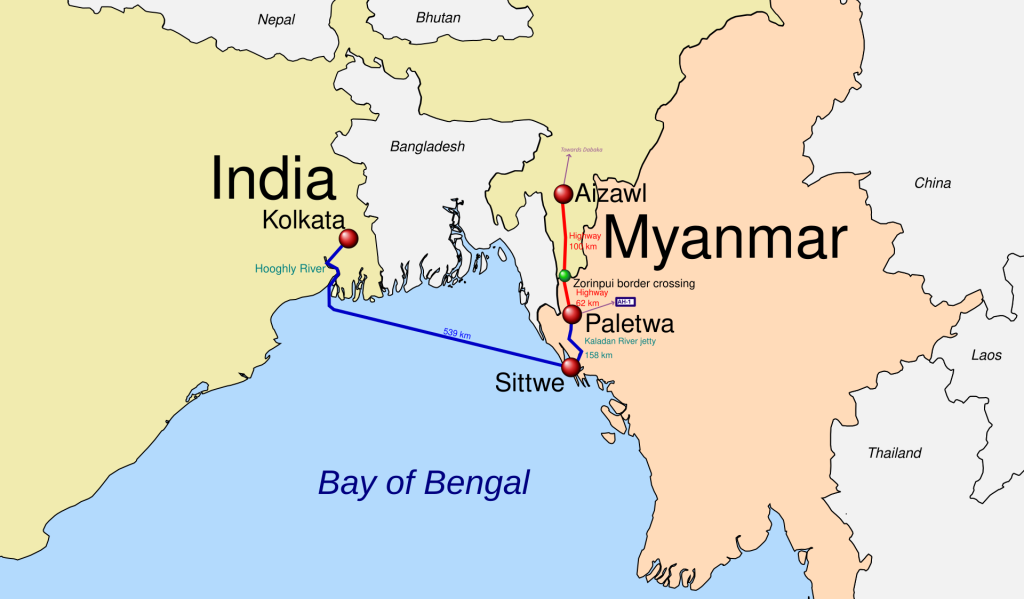
The Kaladan Multi-Modal Transit Transport Project is a strategic infrastructure initiative jointly developed by India and Myanmar to enhance connectivity between India’s Northeast and the Bay of Bengal, bypassing the narrow Siliguri Corridor and Bangladesh.
Though this enterprise is expected to be completed in 2027, its passage through Myanmar’s insurgency prone Chin state remains an impediment. “After elections and with the acceleration of the peace process, we hope we can full leverage this strategic project between Myanmar and India,” says Khin Yi, chairman of the Union Solidarity and Development Party of Myanmar in a conversation with Katehon.
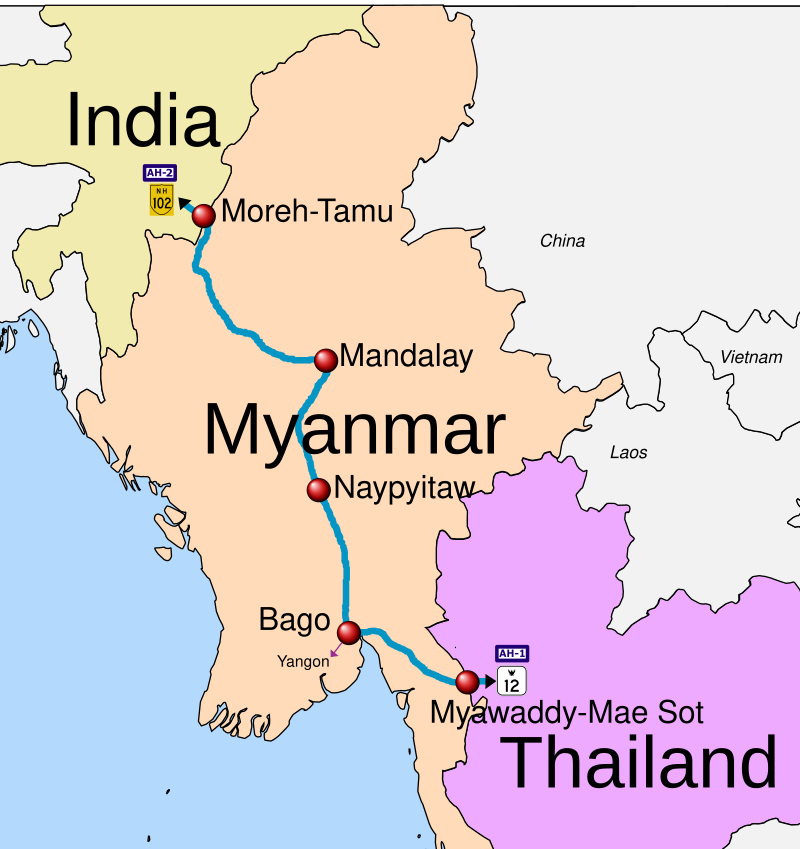
Equally strategic is the ATH, a symbol of New Delhi’s Act East Policy, which will link India with Myanmar and Thailand. From Moreh in India’s Manipur state, the highway enters western Myanmar at Tamu, before passing through Kalewa and Yagyi, the junction between western and central Myanmar. From Yagyi the road passes through the Monywa and Mandalay, the central node of the project. From there it enters eastern Myanmar, terminating at Tachileik, passing through Meiktila, Taunggyi and Kyaingtong.
Myanmar’s geopolitical pivot towards Eurasia and multipolarity is also reflected in the geoeconomic space.
Riding on Myanmar’s bid to partner the SCO and the BRICS+, Myanmar has also mutated its external economic engagements. “We are already members of the Regional Comprehensive Economic Partnership (RCEP) which gives our international economic engagements an entirely new perspective,” says Dr. Wah Wah Maung, Myanmar’s dynamic new minister for Investment and Foreign Economic Relations.
The minister was referring to the world’s largest free trade agreement, encompassing 15 Asia-Pacific countries and covering nearly 30% of global GDP and population.
In her tastefully decorated office in Naypyidaw, a city that was rocked by the March earthquake, she points to new opportunities that Myanmar can avail in the rapidly transitioning international geopolitical environment. “Quite silently we are building new international partnerships. We are observers at the Eurasian Economic Union (EAEU) forum, dialogue partners at the SCO and seeking membership of the BRICS. There is also a special emphasis to build closer ties with Russia, Belarus, China, and India through the formation of joint economic committees,” observes Dr. Wah Wah Maung.
At the Union Election Commission (UEC) office in Naypyidaw, there is quiet confidence that credible elections can be staged. “We will hold elections in three phases. In the first phase on December 28, we will hold elections in one or two townships. But in the second phase voting will be conducted in 100 townships,” says U Aung Myo Lwin, Deputy Director General of the UEC. He points out that polling in 56 townships will not be held because of the security situation, but eventually most of the townships will be covered through by-elections.
The election officials point out that so far election observers from the ASEAN and the BIMSTEC have been invited, along with sections of the international media to ensure the credibility of the polls, following which, there are big plans to take the country forward.