
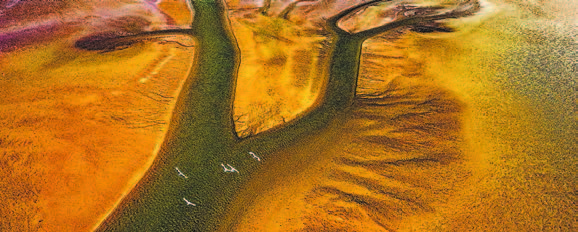
IN mid-September, the Maqu wetlands in Gansu province are a picturesque scene of lush grasslands stretching towards the horizon like a green carpet, with rivers and waterways shimmering in the late summer sun.
A bridge spanning the Yellow River connects Qinghai province, where the river originates in the west, with the Maqu wetlands in the east.
The Yellow River winds its way through Maqu county for 433 kilometres, with more than 300 of its tributaries flowing through vast grasslands and wetlands.
These waterways replenish the Yellow River with nearly 10 billion cubic metres of water a year, making it a crucial water source conservation area in the upper reaches of the river.
Ma Jianyun, chief engineer of the forestry technology comprehensive service station at the county’s natural resources bureau, points at photos taken before and after to show the success of restoration efforts in recent years.
“Look at how the barren riverbanks have turned lush and green,” he said. “The effects of desertification control are obvious.”
President Xi Jinping stressed improvement in conservation efforts of the river basin and its high-quality development when he chaired a symposium in Lanzhou, Gansu’s capital, on 12 September.
Xi underlined the need to promote new progress in ecological protection across the basin, green transformation, high-quality development, and improvement in the people’s livelihood.
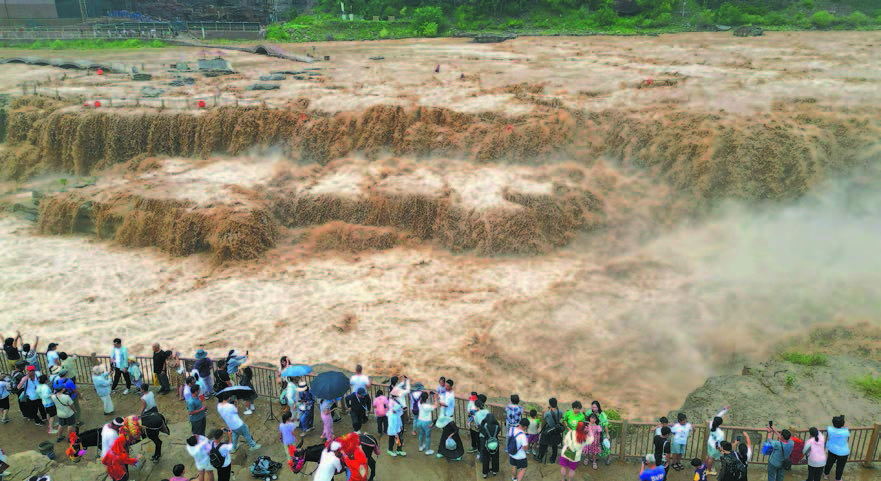
The Yellow River, revered as China’s Mother River and a cradle of civilisation, flows through nine provinces and autonomous regions, and affects the lives of 420 million people.
In October 2021 a comprehensive outline on protecting and developing the Yellow River Basin was published, aiming to guide policy formulation and engineering projects to tackle the basin’s unique challenges.
The implementation of the national Yellow River Protection Law in April last year, along with provincial regulations tailored to local conditions, improved governance and protection of the river.
“The ecological protection and high-quality development strategy in the Yellow River Basin, as well as policies and regulations such as the Yellow River Protection Law, have provided us with a foundation for our work,” said Chen Xiaowei, director of the Yellow River channel management station in Lanzhou.
Chen and his team patrol the river to monitor its condition, and they publish information about policies and regulations to keep people abreast of what is going on.
In the 1990s, Maqu faced significant grassland desertification problems along the Yellow River because of permafrost degradation, frequent river course changes and wind erosion. This led to water conservation and biodiversity being compromised. On windy days, for instance, sand would blanket the grasslands, posing problems for local herders.
In 2021 Gansu set up an integrated protection and restoration project for its mountains, waters, forests, lakes, grasslands and sand resources in the upper Yellow River Basin to restore degraded grasslands and wetlands, and to control erosion.
By the end of last year more than 42,000 hectares of land along the Yellow River in Maqu had been restored.
Chopa Dondrub, 32, has long been aware of the ecological changes in Maqu, his hometown.
In 2019, after graduating from Southwest Minzu University with a master’s degree in ethnology, he returned home and established the Maqu County Ecological Environment Protection Association.
One of his responsibilities is to work with the local community to deal with the issue of black soil patches, a consequence of alpine vegetation degradation. If left unattended they can expand, affecting soil conservation and posing an environmental threat.
“Black soil patches are soft, and when you walk on them you may find your shoes sinking into them,” Chopa Dondrub said.
The process of restoring the patches is not complex but requires attention to detail and patience, he said.
He and his volunteers plant grass seeds in spring, which are a metre high by November, successfully covering the black soil patches.
Over the past five years he and his team have restored tens of thousands of spots affected by black soil patches, with the areas varying in size from 1 square metre to 10 sq m.
# The Global New Light of Myanmar