
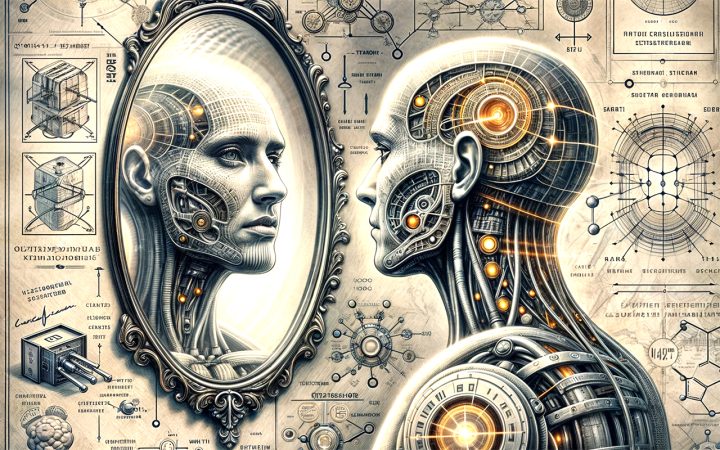
Human beings, whose scientific name is Homo sapiens, belong to the kingdom Animalia. The functioning of this kingdom is determined by instincts and specific action patterns, which are, in turn, prescribed by inherited neurological structures. As great as the development within the animal kingdom is, certain basic elements of its existence remain the same. The animal lives through the biological laws of nature. Animal existence is one of the harmonies between animals and nature, not in the sense that the natural conditions do not often threaten the animals and force them to a bitter survival but in the sense that the animals are equipped by nature to cope with the very conditions they are to meet to the extent which they have become adapted in an evolutionary process. Self-awareness, reason and imagination tend to disrupt the harmony which characterizes animal existence. Human existence makes all the difference in this respect from that of all other organisms; it is in a state of constant and unavoidable disequilibrium. Then, the problem of a man’s existence is unique in the whole of nature – he has fallen out of nature, as it were, and is still in it, i.e., he is partly divine, partly animal-like, partly infinite, or partly finite. Whatever is said, the human needs and passions stemming from existence are relatedness versus narcissism, transcendence, rootedness, sense of identity, and a frame of orientation and devotion.
The necessity to unite with other living beings is imperative to the fulfilment of which a man’s sanity depends. Even if all his physiological needs were satisfied, he would still experience his state of loneliness and individuation as a prison from which he had to break out in order to retain his sanity. There are, however, several ways by which this union with other living beings can be sought and achieved. Humans can attempt to become one with the world by submission to a person, a group or an institution. Another possibility of overcoming separateness in the opposite direction is that humans can try to unite themselves with the world by having power over it and thus transcending their individual existence by domination. The common element in both submission and domination turns out to be the symbiotic nature of relatedness. But noticeably enough, the realization of sadistic and masochistic passions never leads to life satisfaction. Since the ultimate goal of these passions is defeat, they destroy the sense of integrity. There should be only one passion that satisfies a man’s need to acquire a sense of integrity and individuality. This is nothing but love. One fully understands the need to be related only if one considers the outcome of relatedness failure of any kind or one appreciates the meaning of narcissism.
Another aspect of the human situation closely connected with the need for relatedness is a human being as a creature. He is driven by the urge to transcend the role of a creature, the accidentalness and passivity of his existence, by becoming a creator. Of course, humans are able to create life together with all other living beings, but with the difference that he alone becomes aware of being created or being a creator. In the act of creation, humans transcend themselves as lovely creatures and raise themselves beyond the passivity and accidentalness of their existence into the realm of purposefulness and freedom. The need for transcendence lies in one of the roots of love, art, religion, or material production. In the act of destruction, a man sets himself above life. Thus, his ultimate choice, inasmuch as he is driven to transcend himself, is to create or destroy, in other words, to love or hate. Destructiveness is a secondary potentiality rooted in the very existence of human beings and having the same intensity and power as any human passion can. Creation and destruction are not two independent instincts, but they are both answers to the same need for transcendence. The will to destroy must rise when the will to create cannot be satisfied. The satisfaction of the need to develop leads to happiness, but destruction leads to suffering, most of all for the destroyer himself.
Humans can sever or dispense with their natural roots only insofar as they find new human roots, and only after they have found those roots can they feel at home again in this world. Not surprisingly, they see a deep craving in man not to stay away from the natural ties, to fight against being torn away from nature, mother, blood and soil. In fact, these pathological phenomena in individual life have their parallel in the evolution of the human race. The most distinctive expression of this lies in the fact of incest taboo universality, which is known even in the most primitive societies. The incest taboo is a necessary condition for all human development, not for its sexual but for its affective aspect. The positive aspect is a sense of affirmation of life, freedom, and equality, which pervades the matriarchal structure. As long as men are children of nature and children of mothers, they are all equal, have the same rights or claims, and the only value which counts is that of life. On the other hand, the negative aspect of the matriarchal structure is that a man is blocked from developing his individuality and reason; he remains a child incapable of progress. Only when he succeeds in creating his reason and love further than he has done so far, only when he can build a world based on human solidarity and justice and only when he can root in the experience of universal brotherliness will he have found a new human form of rootedness and will he have transformed his world into a genuinely human home.
As with the need for relatedness, transcendence, and rootedness, this need for a sense of identity is so vital that a man cannot remain sane if he does not find some way of satisfying it. In the development of the human race, the degree to which a man is aware of himself as a separate self relies upon the extent to which he has emerged from the clan and the extent to which the process of individualization has improved. For sure, the member of a primitive clan might express his sense of identity. In the majority, individualism is not much more than a facade behind which the failure to achieve an individual sense of identity is hidden. Many substitutes for a really personal sense of identity are endeavoured for and found. Herein, nation, religion, class and occupation all serve to furnish a sense of identity. In actuality, the problem of the sense of identity is not a problem solely concerning the human mind and thought. The need to feel a sense of identity usually stems from the very condition of human existence, and it is also the source of intense striving. Behind the intense passion for herd status and conformity stands this need, which is sometimes even stronger than the need for physical survival. People all over the world are willing to risk their lives, give up their love, surrender their freedom and sacrifice their own thoughts for the sake of being one of the herds, thus conforming and revealing a sense of identity, even though it is an illusory one.
The fact that a man has reason and imagination leads to the necessity not only for having a sense of his own identity but also for orienting himself in the world intellectually. This need can be compared with the process of physical or psychomotor orientation, which develops in the first years of life and is completed when the child is able to walk by himself, touch and handle things, knowing what they are. The need for a frame of orientation takes place on two levels. On the first level, the more fundamental need is to have some frame of orientation regardless of whether true or false. Unless a man has such a subjectively satisfactory frame of orientation, he cannot live sanely and will suffer psychologically. On the second level, the psychological need is to keep in touch with reality by reason so as to grasp the world objectively. Although the brain capacity of the human race has biologically remained the same for thousands of generations, it takes a long evolutionary process to arrive at objectivity. What is at stake in the latter case is his happiness and serenity, and not his sanity. That will become very clear if one studies the function of rationalization. The answers given to a man’s need for a system of orientation and an object of devotion differ widely in both content and form, ranging from (i) animism versus totemism, (ii) atheism, and (iii) purely philosophical beliefs to (iv) monotheism that give a solution to the human quest for life meaning.
#TheGlobalNewlightOfMyanmar